

Foresight-driven Innovation: How to build a future-proof innovation portfolio

- Conventional innovation methods optimize for the present. In contrast, foresight-driven innovation integrates strategic foresight with innovation management to anticipate potential disruptions. This approach uses multiple plausible future scenarios to identify opportunity spaces that are robust across different versions of how the environment might develop.
- The process runs from horizon scanning to a prioritized portfolio: identify emerging trends and drivers, assess critical uncertainties, build scenarios, frame opportunity spaces, and define a balanced mix of core, adjacent, and transformational bets.
- AI-powered strategic intelligence makes this process continuous, keeping the innovation portfolio aligned with live trend evidence rather than static annual planning assumptions.
Most organizations innovate continuously, yet find themselves improving what already exists rather than building for what is coming. The reason is structural: conventional innovation methods are anchored to present customer needs and near-term financial validation, which systematically filters out the longer-horizon opportunities where genuine competitive advantage is still available.
The organizations that break out of this cycle share a common shift in approach: rather than starting from present needs and working forward, they start from plausible futures and work back. Foresight-driven innovation provides the method to do this systematically.
What is foresight-driven innovation?
Foresight-driven innovation (FDI) combines strategic foresight with innovation management to shape future opportunity spaces, areas where new value could be created, rather than only solving today's problems. Instead of asking what users need today, it asks what users and markets might need across different possible futures, and where the organization should invest now to be positioned when those futures arrive [1].

The contrast with design thinking is worth noting. Design thinking focuses on current user needs and quickly iterates towards short-term solutions. While it is effective in stable environments, it tends to struggle when conditions are changing. In contrast, Foresight-Driven Innovation (FDI) looks at longer time horizons and a broader perspective. It uses emerging signals, trends, and scenarios to explore how customer needs and competitive dynamics might evolve across multiple possible futures.
The output is a futures-oriented portfolio that balances three layers: core innovation, incremental improvements to existing products and markets, adjacent innovation into related spaces, and transformational innovation oriented toward longer-horizon shifts [3]. Each layer is calibrated to a different time horizon and level of uncertainty. Together, they ensure the organization is not fully committed to a single version of the future.
Why foresight-driven innovation matters now?
The incremental trap is not a consequence of insufficient effort. It is the predictable outcome of using methods built for stability in conditions of accelerating uncertainty. When innovation processes are anchored to present user needs and near-term financial validation, they systematically filter out the signals that point further out, precisely where first-mover advantage is still available [1]. Leaders can no longer rely on incremental improvements; they must consciously choose and build the future they want.
Foresight-driven innovation treats uncertainty as the raw material for exploration rather than a reason to wait. By working across plausible futures rather than optimizing for a single forecast, it identifies opportunity spaces that hold value regardless of which version of the future materializes.
The benefits show up in how organizations build competitive position:
- Earlier positioning. Acting on emerging trends before they become widely visible leaves room for genuine differentiation. By the time a development appears in industry reports, most organizations have already begun to respond.
- More resilient and robust portfolios. A portfolio calibrated across multiple time horizons is less vulnerable to single-point disruptions than one concentrated in near-term, incrementally validated bets.

- Stronger strategic alignment. When innovation choices are grounded in the same trend intelligence that informs strategy, the two functions reinforce rather than ignore each other.
- Continuous relevance. An always-on approach to trend monitoring means innovation roadmaps can be updated as evidence shifts, rather than waiting for the next annual cycle.
Hasbro illustrates what a well-balanced foresight-driven portfolio looks like in practice. As the gaming industry began shifting in the mid-1990s, with personal computers, handheld devices, and the emerging internet pointing toward a fundamental change in how games would be played and distributed, Hasbro did not abandon its core board game catalogue. Instead, it kept the core intact while exploring adjacent opportunities in digital versions of existing brands and new e-commerce channels, and making longer-horizon bets on original digital titles and entirely new demographics: grandparents with disposable income, commuters on handheld devices, and markets outside the United States that its traditional model had not reached [2]. Between 2001 and 2015, across both the dot-com bust and the Great Recession, Hasbro’s stock rose from $11 to $72, while Mattel, its main competitor, rose from $15 to just $25 over the same period [2]. This demonstrates that a portfolio built across multiple time horizons, grounded in anticipation rather than reaction, outperformed a narrower strategy during challenging market conditions.
How to implement foresight-driven innovation?
Foresight-driven innovation is a repeatable cycle that connects tomorrow’s opportunities to today’s innovation bets. It scans for trends and drivers, constructs plausible futures, identifies where new value could be created across those futures, and translates the strongest opportunities into a prioritized portfolio with clear roadmaps and continuous monitoring.

A typical workflow
- Set the innovation focus. Define the strategic question, the time horizon, and the key domains to explore: technology, markets, regulation, society, and environment. Clarity here determines the relevance of everything that follows.
- Scan and map trends and drivers. Identify relevant trends and factors of change across the defined domains. Assess each driver for impact and uncertainty to isolate a shortlist of the most critical and genuinely uncertain forces, the raw material for scenario construction.
- Build future scenarios. Combine the most critical uncertainties to construct 2–4 plausible futures, each with a distinct logic and narrative. Scenarios are not predictions; they are structured tools for exploring how drivers could interact and what each combination would mean for customer needs, competitive dynamics, and where new value might emerge.
- Identify and frame opportunity spaces. Within each scenario, map shifts in customer needs, pain points, and value creation logic. Cluster insights into opportunity areas per scenario, then synthesize across scenarios into multi-future opportunity spaces, areas where new value could be created regardless of which future materializes.
- Prioritize and define the portfolio. Evaluate each opportunity space against market potential, customer urgency, and strategic fit. Define “big bets” and “no-regret” areas. Ensure the portfolio balances core, adjacent, and transformational innovation [3] rather than concentrating on a single horizon.
- Build roadmaps and monitor continuously. Translate priority spaces into innovation initiatives, proofs of concept, and sequenced roadmaps. Keep the portfolio live by monitoring the trends and signposts that underpin each priority space, adjusting priorities as evidence shifts rather than waiting for the next planning cycle.
Where does Trendtracker fit in the workflow?
Running the FDI process at the scale and continuity it requires demands an intelligence layer that goes beyond periodic trend reports. Trendtracker supports each step of the workflow, grounding every output in an organization-specific context rather than generic industry averages.
- Set the innovation focus. Trendtracker's Customer Context capability tailors all signal intelligence to the organization's specific profile, strategic objectives, competitive landscape, key stakeholders, and the macroforces most relevant to its environment. This ensures that what reaches the innovation team reflects what is emerging for their organization, not for an average company in a given sector.
- Scan and map trends and drivers. The platform continuously monitors over 500 million documents across 18,300+ sources, covering emerging technologies, market trends, competitive intelligence, societal shifts, and policy developments. AI-derived scoring, Strength, Strength Momentum, Forecasted Strength, and Horizon, surfaces the most decision-relevant drivers and supports impact and uncertainty assessment.
- Build future scenarios. For each shortlisted driver, the AI Analyst generates multiple development paths: plausible ways the driver could evolve, which become structured input for scenario construction. Once scenarios are built, Trendtracker sets signpost triggers and continuously monitors them, keeping scenario assumptions up to date as the environment evolves.
- Identify and prioritize opportunity spaces. Trendtracker enriches each opportunity space with supporting trend evidence and early indicators. Teams can combine AI-derived trend scores with a structured stakeholder survey, rating each opportunity on impact and strategic fit, to produce a prioritization grounded in both external evidence and internal judgment.
- Monitor and update. Trendtracker keeps priority spaces and innovation roadmaps under continuous review. When trend momentum shifts or new signals converge on a priority area, the change surfaces in real time, ensuring innovation priorities reflect current evidence rather than last year’s assumptions.
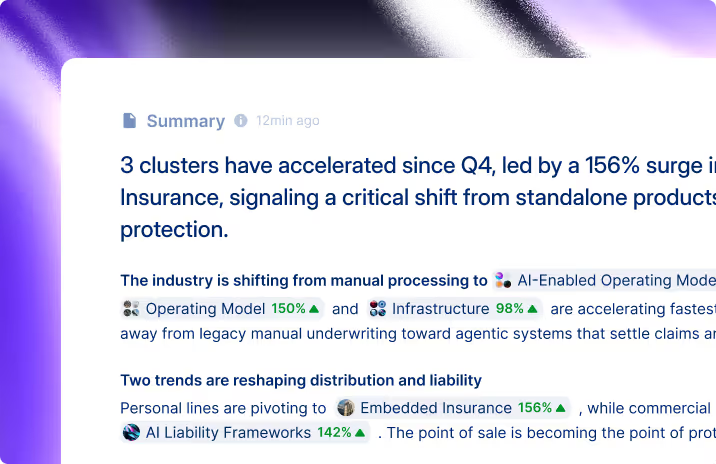
Trendtracker acts as the AI-powered intelligence layer of the FDI process, from initial horizon scan through to portfolio monitoring. It connects trend intelligence to innovation decisions and keeps both aligned as the environment evolves.
Conclusion
Foresight-driven innovation involves creating an innovation strategy that remains relevant as the world evolves. By starting with future possibilities instead of current limitations, testing ideas across various scenarios instead of relying on a single forecast, and maintaining a balanced portfolio that integrates short-term stability with long-term positioning, organizations can shift from reactive adaptation to intentional strategic decision-making.
This process is both repeatable and scalable. Its sustainability comes from an intelligence layer that keeps the organization continually informed, ensuring that the gap between emerging trends and organizational goals continues to narrow.
References
[1] Jonasson, L., Kruse, M., & Pillot de Chenecey, S. (2024). “How organizations can connect innovation with foresight.” World Economic Forum, September 2024. https://www.weforum.org/stories/2024/09/how-to-connect-innovation-with-foresight/
[2] Govindarajan, V. (2016). “Planned Opportunism: Using weak signals to spur innovation.” Harvard Business Review, May 2016.
[3] Nagji, B., & Tuff, G. (2012). “Managing Your Innovation Portfolio.” Harvard Business Review, May 2012. https://hbr.org/2012/05/managing-your-innovation-portfolio