
What Is a Strategic Intelligence Platform? A Guide for Enterprise Teams

- Most enterprise planning infrastructure was built for a world that no longer exists. Annual cycles and periodic research were designed for an era when the window between signal and consequence was measured in years. That window has compressed, and the gap is now a material business risk.
- Four structural failure modes explain why traditional intelligence keeps falling short. Fragmented workflows, periodic snapshots, bandwidth that doesn't scale, and ungoverned AI combine to create a reaction gap that no amount of effort can close.
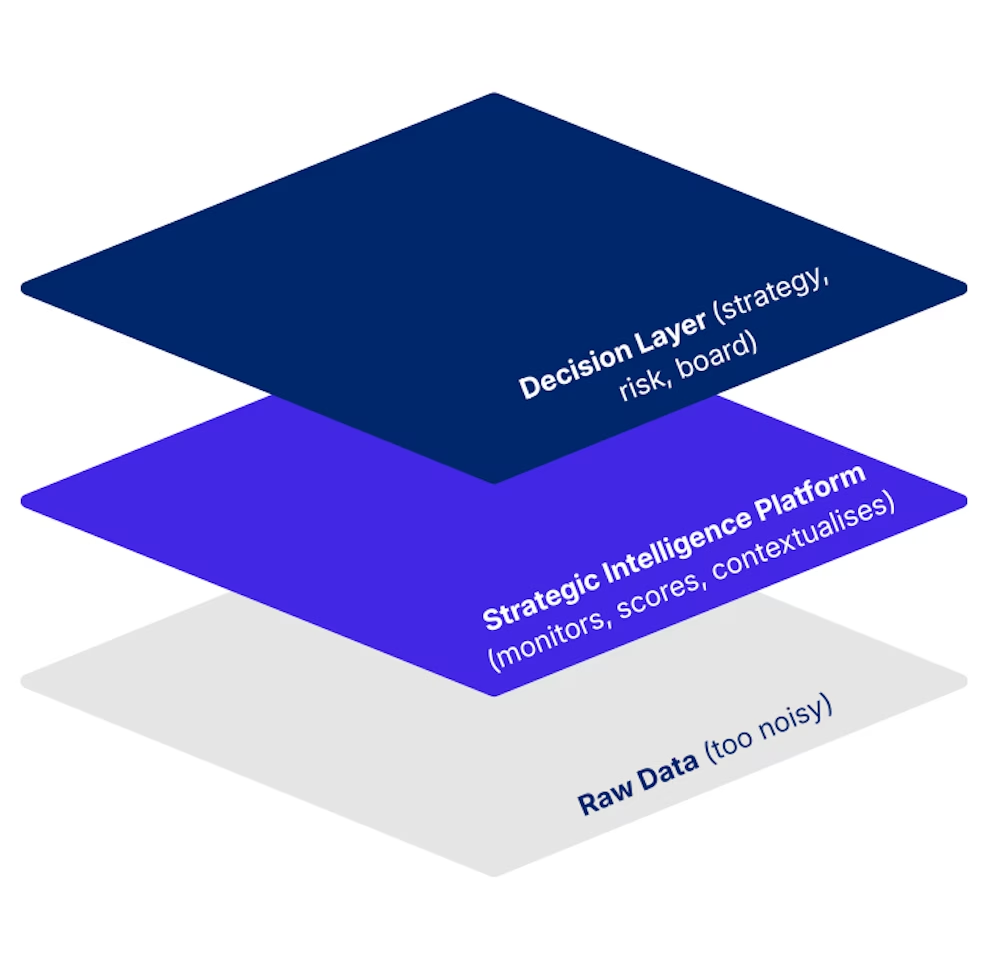
- A strategic intelligence platform occupies a specific position in an enterprise's information architecture. It sits above raw data, which is too noisy to act on, and below the decision layer, where it is already too late to intervene and five functions define whether a platform actually belongs in that category.
- Purpose-built strategic intelligence differs from generic AI in one critical way. A platform like Trendtracker maintains a continuously updated, scored, and auditable model of the external environment, built to be defended in a boardroom, not just to sound plausible.
The external environment is moving faster than enterprise planning was built to process. Regulatory shifts, technology and social disruptions, competitive moves, and macroeconomic signals are converging at once, often across industries, faster than any periodic research cycle can track. A strategic intelligence platform is built for that gap. It is an always-on system that continuously monitors, scores, and contextualises external signals, from emerging trends and regulatory shifts to competitive moves and technology disruption, and turns them into intelligence built for the boardroom, for enterprise strategy, risk, innovation, and foresight teams. Unlike market research tools or generic AI assistants, it operates as a persistent intelligence layer: sitting above raw data, which is too noisy to act on, and below the decision, where it is already too late to intervene.
What Strategic Intelligence Actually Means
Strategic intelligence has been studied as a formal discipline for longer than most enterprise software categories have existed. Peer-reviewed research consistently defines it as the organised gathering, analysis, and interpretation of information needed to support decision-making and strategic planning [1]. Competitive intelligence pioneer Leonard Fuld made a similar case decades ago: that intelligence only works as a constant practice, gathered daily rather than confined to a formal planning cycle, since competitors and conditions don't pause to accommodate anyone's schedule [2]. That distinction matters: strategic intelligence describes an ongoing process, sustained over time, not a one-time deliverable, and in a contemporary enterprise context it runs continuously.
For enterprise teams sorting out what they actually need, the differences from adjacent categories are worth being precise about.
- Market research is episodic and backward-looking, telling you what was happening in a market rather than what's happening now.
- Competitive intelligence, in its traditional form, narrows in on specific competitors and feeds that information to sales and marketing teams rather than to strategy or risk functions.
- Generative AI tools reason from a fixed training set rather than observing the world in real time, however confident they sound doing it.
- Consultant reports deliver a synthesised view at a single point in time, one that starts ageing the moment it's published.
Strategic intelligence sits apart from all four. It never stops watching, it looks past any single competitor to the wider environment, and it works from what's happening now rather than a dataset frozen at training time, still delivering long after a one-off report would have gone quiet. That distinction stopped being academic the moment the volume and speed of real-world signals outran the cycles most organisations still plan around.
Why Enterprise Intelligence Keeps Falling Behind

There's no shortage of signals. Every week, thousands of regulatory publications, academic papers, patent filings, startup funding announcements, earnings calls, and news articles emerge, each one a piece of what enterprise teams are supposed to be planning against. The real issue isn't access to information so much as how slowly most organisations can turn it into something usable, given how fast the environment generating it keeps moving.
Enterprise strategy was built for a slower world. That world itself has been speeding up: the pace at which new technologies displace the old has been compressing for decades, and each disruption rarely stays contained to its own sector. The pattern is non-linear, not gradual, change looks slow for years and then happens all at once, and the resulting shocks tend to spread outward into social, environmental, and political systems well beyond the industry where they began [3]. Annual planning cycles, quarterly trend reports, and consultant-led horizon scans were designed for an era when the gap between signal and consequence was measured in years. That gap has closed. Geopolitical volatility and regulatory change, climate and resource pressure, AI-driven disruption, and shifting consumer behaviour now arrive together rather than in sequence, and a shift in one industry routinely triggers pressure in another before any single function has caught up. What separates organisations that manage this well has less to do with the size of their research budget than with how clear their intelligence infrastructure is underneath the decisions they're making.
McKinsey's 2026 research backs that up: at top-performing companies, nearly half of respondents say their technology planning cycles are now fully integrated with business planning, up from just 18 percent in the prior survey [4]. McKinsey describes the system underneath that shift as an intelligence layer, a single set of data, AI models, and decision-making processes coordinating the enterprise as a whole rather than sitting inside any one function. Most organisations haven't built one yet. The ones that have are pulling ahead.
Understanding what effective infrastructure looks like becomes easier when we examine its breakdowns. The shortcomings of traditional enterprises accumulate over time: a risk that is highlighted in a competitor's earnings call before it appears on your risk register, a technology that your innovation team is still assessing while a rival is already piloting it, or a regulatory change that prompts a question from the board that your strategy team struggles to answer confidently because the necessary background information is six months old. While strategy, risk, and foresight teams work diligently, these issues are structural in nature, and they tend to compound one another, regardless of the individual effort put into overcoming them.
- Fragmented workflows. Insights live across analyst documents, consultant decks, newsletter subscriptions, and industry reports, with no shared system of record and no context layer connecting any of it to the organisation's specific priorities. Decisions get made on whichever fragment reached the right person at the right time.
- Human bandwidth that doesn't scale. Manual research is slow and expensive, and external consultants produce static outputs that walk out the door at the end of the engagement. No human team, however talented, can monitor eleven distinct signal types across thousands of sources without introducing gaps.
- Stale intelligence by the time it's used. It's the same timing problem already described in market research and consultant reports, periodic snapshots running against a continuous environment, and it hits internal teams just as hard: by the time intelligence is gathered, synthesised, and distributed, the signal it describes has often already moved.
- Ungoverned AI. The same currency problem already noted in generic AI tools shows up here in a more dangerous form: large language models now widely used in strategy work generate confident-sounding analysis with no source traceability and no way to distinguish what they retrieved from what they inferred.
Gartner projects that by 2026, enterprises applying AI governance controls will increase decision-making accuracy by eliminating up to 80% of faulty and illegitimate information [5].
The result is a reaction gap: organisations discovering risks and opportunities only after they've already become consequences. Deloitte's own guidance for enterprise risk functions makes a similar point, that a dynamic approach to ERM, powered by strategic intelligence, has moved from an aspiration to an operating expectation for many companies [6].
What a Strategic Intelligence Platform Does: Five Defining Functions
Closing that reaction gap takes a specific position in the enterprise's information architecture, one most organisations haven't built yet. A strategic intelligence platform holds that position: above the raw, unfiltered flow of global data, and below the room where strategy, risk, and the board actually make their decisions. What matters in practice is what that position demands of it. It has to take the full scope of external signals relevant to an organisation's specific context, score and prioritise them, and surface the ones that actually matter, with enough transparency and traceability that the intelligence holds up when someone asks where a specific number or claim came from.
Understanding what a strategic intelligence platform does in practice is the most useful lens for evaluating whether a given tool actually belongs in that category. Five core functions define it, and the degree to which a platform delivers on each determines its actual value to enterprise teams.
1. Continuous signal monitoring is the foundation. A strategic intelligence platform does not wait to be asked a question. It watches, permanently, across the full range of sources that matter. In practice, that means eleven distinct indicator types: patents, R&D filings, academic publications, earnings calls, grants, partnerships, product launches, news, investment and acquisition activity, company formation data, and industry benchmarks, each chosen because it reveals directional change before that change surfaces in any report or dashboard. Together they give the platform a forward view across the full external landscape: what capital is backing, what research is building, what regulation is forming, and what competitors are prioritising.
The distinction between a monitoring platform and a search tool matters enormously. A search tool gives you what exists when you look. A monitoring platform tells you what changed since you last looked, and flags it before you would have thought to ask.
Trendtracker continuously indexes this full indicator set across more than 20,000 curated sources and approximately one billion documents. New signals are ingested as they are published. Trend strength scores are recalculated and updated monthly. The intelligence is always current, not periodically refreshed on a research request.
2. Signal scoring and prioritisation is what separates intelligence from information. Without a mechanism for quantifying which signals are gaining momentum, a monitoring platform is still a firehose. More signal than any team can process.
Trendtracker's proprietary Trend Strength Index scores every trend on a 0-10 scale, drawing on the full set of indicators above to quantify momentum across five dimensions: market momentum, regulatory change, investment flows, technology disruption, and competitive intensity. Updated monthly, it gives teams a ranked, quantified view of what is actually moving. Not a stream of undifferentiated updates to filter manually, but a scored intelligence layer that tells analysts where to direct their judgement.
6000+ trends scored and maintained continuously. Every score updated monthly and traceable to the underlying patent filings, journal publications, investment rounds, and partnership announcements that drove it.
3. Context-configuration is the function that most generic tools fail to deliver, and the one that most directly determines whether intelligence is actually useful. A platform that monitors everything equally is not a strategic intelligence platform. It is a news aggregator. What makes intelligence strategic is that it is shaped by the organisation's specific context: the industries it operates in, the geographies that matter, the initiatives currently running, the risks currently tracked.
Trendtracker is configured around that context from the outset, so every signal, briefing, and strategic recommendation is filtered through it. The output arrives already relevant to the team's priorities, not as a broad market feed that requires a separate filtering pass before analysis can begin.
4. Structured, role-appropriate outputs ensure that intelligence reaches decision-makers in a form they can actually use. A single undifferentiated dashboard is not sufficient for an organisation where the Chief Strategy Officer needs a planning-horizon view, the Chief Risk Officer needs weak signal detection across regulatory and macro domains, and the innovation lead needs technology maturity signals mapped to a specific investment window.
Trendtracker delivers three distinct output formats built for different needs.
- The Trend Radar provides a continuously updated visual map of trend velocity and maturity across the organisation's strategic landscape, designed for planning conversations and executive briefings.
- The Strategy Brief is a weekly intelligence briefing built entirely around the team's specific Trend Board, covering the biggest shifts ranked by impact, competitor moves mapped against the organisation's trend landscape, and early-stage startup activity as a leading indicator of where an industry is heading.
- The AI Analyst provides deep, on-demand analysis of any individual trend, covering what is changing, why it matters, and what the organisation could do in response. The difference between these outputs and a generic report is that they are structured to land in the hands of a human decision-maker ready to act, not ready to begin research.
5. Traceability, governance, and security is the function that makes strategic intelligence safe to use in high-stakes contexts. In a boardroom, "the AI suggested it" is not a sufficient basis for a strategic decision. Every insight, every trend score, and every signal needs to trace back to its original source. Not as a footnote, but as a first-class feature. That traceability is what allows a Chief Risk Officer to defend an emerging risk assessment to a regulator, or a Chief Strategy Officer to justify a strategic bet to a board.
Trendtracker's knowledge graph maintains source-level evidence trails across every piece of intelligence the platform surfaces. The scoring is quantified and explainable. The intelligence is auditable. And following the completion of its SOC 2 audit, Trendtracker is now SOC 2 certified, providing enterprise teams with independently verified assurance that the platform's security controls, data handling, and operational processes meet the standards required for enterprise deployment. For organisations in regulated industries, including insurance, banking, and financial services, that certification is not a checkbox. It is a procurement prerequisite.
The Teams That Run on Strategic Intelligence
The previous five functions appear the same on a checklist, but what they deliver varies by team. Different departments within an enterprise often face the same underlying problem, yet they use different terminology to describe it. The strategy team refers to it as a blind spot, the risk team calls it a gap in coverage, the innovation team identifies it as pilot fatigue, and the market intelligence team labels it a lag. Despite the different names, they are all describing the same structural issue: the lack of a continuous, governed, and contextualized intelligence layer that connects all these functions.
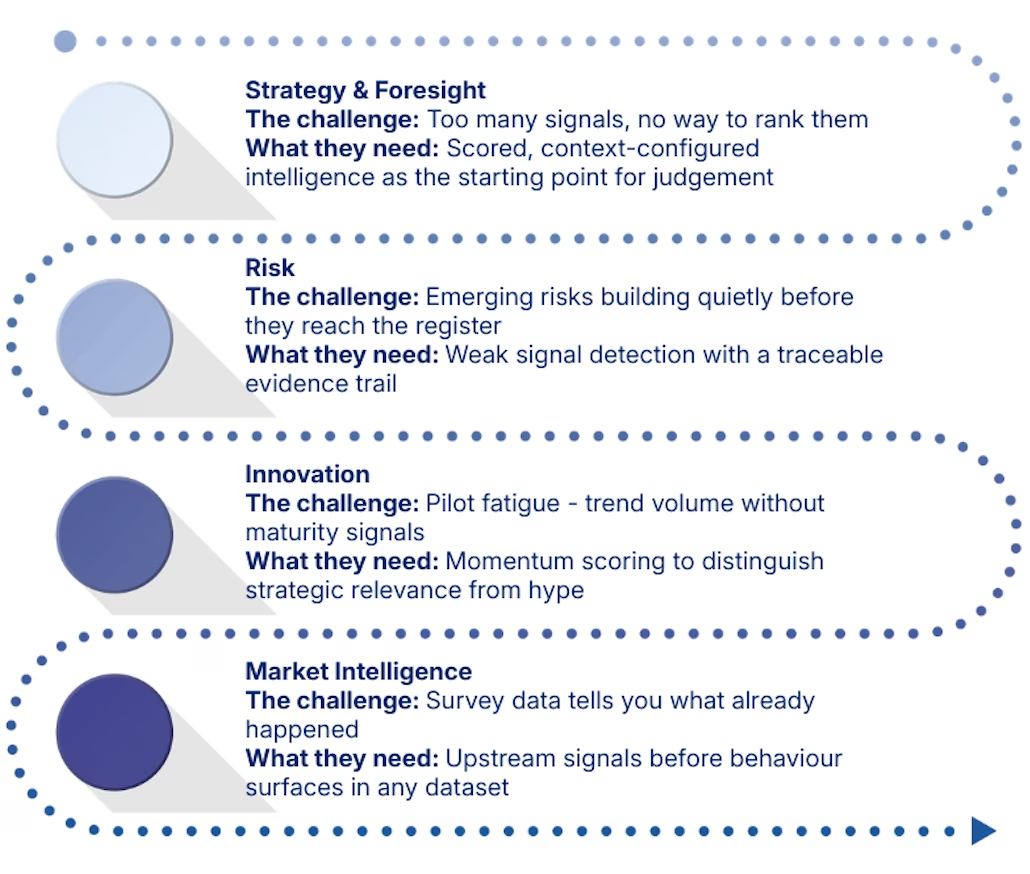
For strategy and foresight teams, one of the challenges is knowing which part of the landscape deserves attention. With thousands of signals in circulation at any point, the question that separates good strategic foresight from noise is a human one: which of these actually matters to us, given where we are, what we are trying to build, and what is already in our risk and opportunity register? Trendtracker gives foresight professionals a scored, ranked, context-configured signal layer as the starting point for that judgement. Rather than spending the majority of their time in collection and filtering, analysts can direct their expertise where it matters: interpreting signals, connecting them to strategic positions, and shaping the forward view. That judgement still belongs to the analyst. The platform's role is making sure it's spent on interpretation rather than on the collection and filtering that used to consume most of the day.
For risk teams, the problem often arrives in the form of a question the risk committee asked that nobody could answer confidently because the signal that would have informed the answer had been building quietly for months in patent filings, regulatory consultations, and investment flows before it appeared on any register. The challenge spans both ends of the risk horizon. On one side, emerging risks that do not yet appear in any register, regulatory shifts forming across jurisdictions, technology disruptions beginning to cross industry lines, macroeconomic signals building at the periphery. On the other, the existing risks already in the register that need continuous monitoring as their strength and trajectory evolve. A risk that was amber six months ago may have moved to red not because of a single event, but because a cluster of upstream signals, patent activity, investment flows, regulatory consultation documents, have been quietly building momentum. Trendtracker tracks both ends of that horizon, surfacing what's not yet named and tracking how what's already known is shifting, with a scored evidence trail that holds up when it's questioned in a risk committee.
For innovation teams, the problem is not finding trends, it is knowing which ones are approaching genuine strategic relevance and which are still years from maturity or moving more slowly than the hype suggests. Most teams call it pilot fatigue: the exhaustion of evaluating signals that never graduate into decisions. Trendtracker's momentum scoring and time-horizon data give innovation teams something firmer than instinct to make those calls on, an evidence base that holds up when a decision has to be defended to leadership rather than taken on collective intuition.
For market and consumer intelligence teams, the constraint is timing. Survey data, panels, and social listening tell you what consumers are thinking and doing now. Or more accurately, what they were thinking and doing when the research was conducted. Trendtracker tracks the upstream signals, patent filings, academic research, regulatory shifts, investment flows, that shape consumer behaviour before it shows up in any dataset, giving analysts a forward-looking foundation to build their interpretation and sector context on top of.
What all of these teams share is a common profile: they operate under high external uncertainty, make decisions with consequential long-term implications, and need intelligence that is governed, explainable, and auditable. The platform handles the continuous work of monitoring, scoring, and surfacing, at a scale and across a source breadth that no analyst team could sustain manually. The outcome depends on the human judgement applied to what it surfaces.
How Trendtracker Pioneered the Category
Trendtracker was founded in 2019 in Ghent, Belgium, on a specific observation: organisations had more access to information than at any point in history, and less capacity to act on it strategically than the volume of that information should have permitted. The platform was built to close that gap. For a deeper look at how Trendtracker is built, how the Trend Strength Index works in practice, and how the platform compares to the specific alternatives enterprise teams most often evaluate, read the full platform overview and see how Trendtracker compares to adjacent tools.
For organisations in insurance, an industry where regulatory change and macroeconomic signals translate directly into underwriting risk, the platform's scored, traceable intelligence layer is particularly consequential.
"The world is changing fast, but Trendtracker cuts through the complexity with AI-powered and human-scored trends to sharpen our decisions." - Hans de Cuyper, CEO, Ageas
In FMCG, the use case shifts: the challenge is knowing which consumer and category signals are structural shifts versus short-term noise before committing to product or market decisions.
"Trendtracker helps us zoom in on the trends that matter to our categories. Being able to tailor insights really makes a difference." - Global Consumer Insights Team, PepsiCo
The shift from periodic research to continuous intelligence is more than a technology upgrade. It is an operating model change.
Enterprise teams have always needed a clear view of the forces shaping their decisions. What has changed is the speed at which those forces move, the breadth of signals that now matter, and the cost of the gap between when something becomes visible and when an organisation acts on it. A strategic intelligence platform does not eliminate the need for human judgement, rather it gives that judgement a foundation that is current, scored, contextualised, and defensible. For strategy, risk, innovation, and foresight teams operating under genuine external uncertainty, that foundation is no longer a competitive advantage. It is the baseline.
References
[1] Paiuc, D., Săniuță, A., & Teacu Parincu, A.M. (2024). Strategic Intelligence: A Semantic Leadership Perspective.Encyclopedia, 4(2), 785–798. https://doi.org/10.3390/encyclopedia4020050
[2] Fuld, L. M. (1995). The New Competitor Intelligence: The Complete Resource for Finding, Analyzing, and Using Information about Your Competitors. John Wiley & Sons.
[3] Arbib, J., & Seba, T. (2020, June). Rethinking Humanity: Five Foundational Sector Disruptions, the Lifecycle of Civilizations, and the Coming Age of Freedom. RethinkX. https://www.rethinkx.com/publications/rethinkinghumanity2020.en
[4] McKinsey & Company (2026, February). McKinsey Global Tech Agenda 2026: How CIOs are shaping enterprise strategy and growth.https://www.mckinsey.com/capabilities/mckinsey-technology/our-insights/mckinsey-global-tech-agenda-2026
[5] Gartner (2023, October 16). Gartner Identifies the Top 10 Strategic Technology Trends for 2024.https://www.gartner.com/en/newsroom/press-releases/2023-10-16-gartner-identifies-the-top-10-strategic-technology-trends-for-2024
[6] Deloitte. Strategic Intelligence: An Integrated Approach to Enterprise Risk Management. Deloitte Center for Board Effectiveness