Transforming Regional Industrial Strategy: How Business Upper Austria Orchestrates Innovation with Trendtracker

In the high-stakes environment of European industrial transformation, Business Upper Austria plays a pivotal role. As the official business location agency of the Province of Upper Austria, Business Upper Austria supports a region responsible for roughly a quarter of Austria’s industrial production and exports. Through nine industry clusters and networks, it connects and supports more than 2,200 partner companies - 81% of which are SMEs.
For a region with such industrial density, strategic foresight is not optional. It directly influences investment decisions, innovation roadmaps, and long-term competitiveness.
The central question needed to address was:
How do we provide consortium partners and SMEs with structured, forward-looking intelligence, to support strategic action in a rapidly changing environment?
Building a Structured Foresight Capability
Recognizing the critical need for foresight, Business Upper Austria is committed to enhancing its capabilities to better serve its partners. This commitment is exemplified in its co-leadership of New Energy for Industry - NEFI, an Austrian innovation network dedicated to promoting industrial decarbonization through collaboration among a diverse group of research institutions, companies, and policy stakeholders. In this role, Business Upper Austria continuously identifies trends and conducts socio-economic analyses while supporting the extensive consortium in shaping decarbonization initiatives that align with their goals.
The challenge was not a lack of information. It was fragmentation.
Trend insights were previously gathered through manual research, conferences, academic publications, and industry reports. While valuable, this approach was time-intensive and difficult to quantify or visualize in a structured way. Preparing workshops and stakeholder sessions required significant effort, and aligning scientific and industrial perspectives was not always straightforward.
NEFI needed a system that could:
- Continuously scan relevant socio-economic and industrial developments
- Structure insights into coherent thematic clusters
- Quantify trend dynamics
- Support stakeholder alignment with visual, evidence-based outputs
Two Radars, One Integrated Intelligence Framework
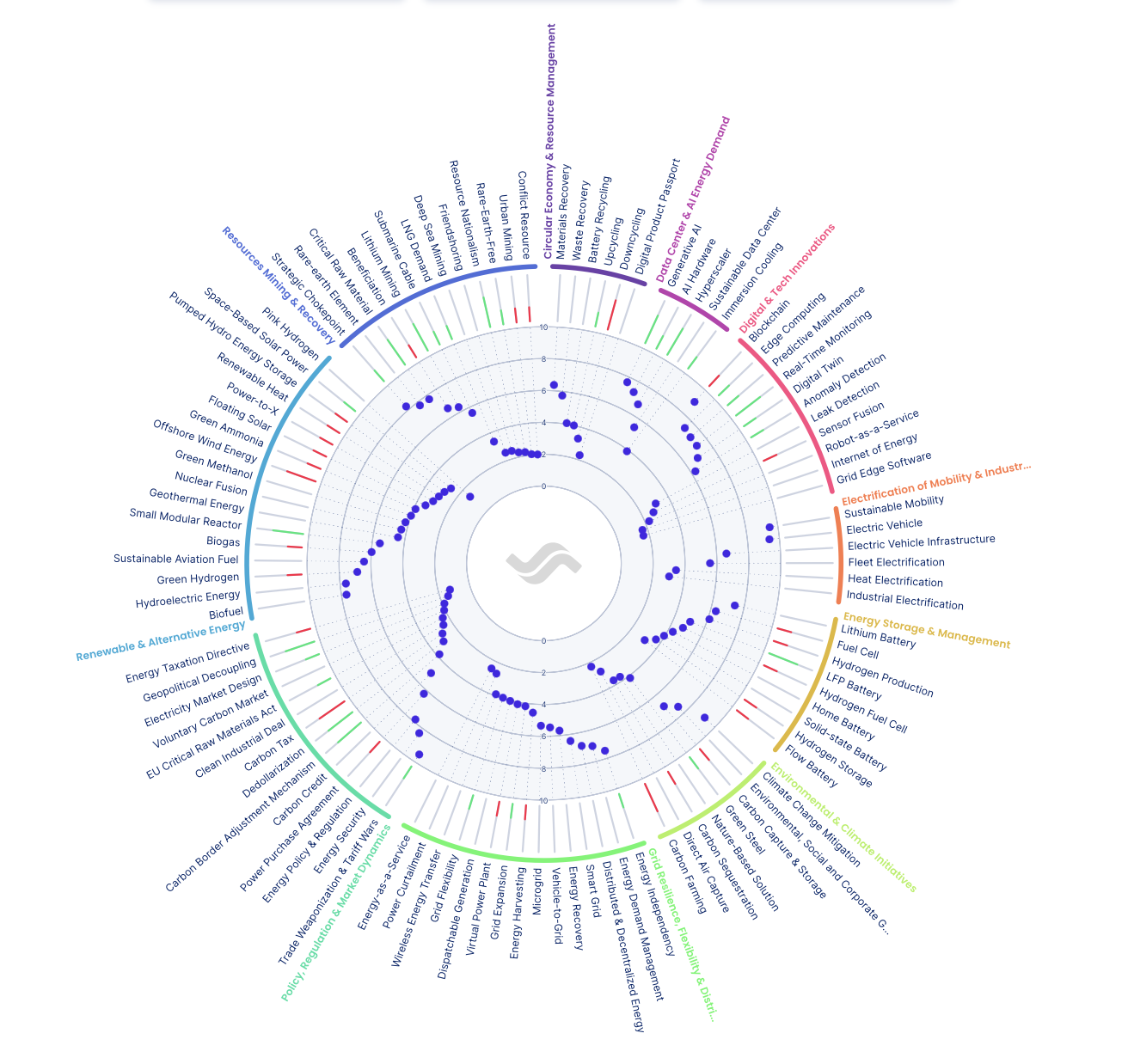
To operationalize foresight, NEFI implemented two complementary Trendtracker radars:
1. General Horizon Scan Radar
A broad radar monitoring socio-economic and regulatory developments impacting industrial strategy at regional and European levels.
2. Sector-Focused Radar
A dedicated radar tailored to the thematic priorities of NEFI, enabling deeper analysis of developments relevant to participating partners.
This dual setup allows NEFI to link macro-level structural shifts with more focused industrial implications, without losing strategic coherence.
Trendtracker’s architecture structures developments hierarchically, distinguishing between broader structural shifts and more specific manifestations. This reduces manual categorization and ensures that discussions are based on a shared, consistent taxonomy.
From Qualitative Discussion to Quantified Prioritization
One of the most significant shifts has been the move from primarily qualitative foresight to quantified trend evaluation.
Trendtracker enables NEFI to:
- Assess trend strength and evolution over time
- Visualize prioritization through radar views
- Compare impact dimensions across themes
- Validate insights with stakeholder input
In a consortium environment that includes scientific institutions, industry leaders, and policymakers, this structure is essential.
Initially, parts of the scientific community requested transparency around the methodology and inputs. Over time, the practical value became evident: the platform does not replace expert judgment, it complements and structures it. It provides a shared evidence base for discussion.
Through survey functionality, NEFI can integrate expert scoring alongside system-generated assessments. This creates a more objective foundation for prioritization and strengthens the credibility of recommendations presented to partners and government stakeholders.
Trendtracker helps us connect the dots early and align stakeholders around a shared evidence base. The sector-focused radar lets us filter noise and go deeper on priority themes, turning trend exploration into an operational foresight capability for SMEs and consortium partners.
Supporting High-Impact Workshops
The benefits are particularly visible in the preparation of innovation and consortium workshops.
Instead of beginning sessions with open-ended exploration, NEFI now enters with:
- Pre-structured thematic clusters
- Visual prioritization matrices
- Clear documentation of trend dynamics
- Shared terminology for discussion
In previous workshops, over 60 relevant developments were scoped and filtered prior to the session.
This allows participants to move more quickly into defining project directions, collaboration opportunities, and implementation pathways, rather than debating the external context.
The result is faster decision-making and more focused sessions.
Ensuring Local Relevance
For a regional agency, geographic precision is critical.
As part of the implementation, German-language and European sources were expanded, while irrelevant geographies were excluded to improve signal relevance.
This ensures that insights reflect the regulatory, economic, and funding realities of the DACH region rather than generic global narratives. For SMEs navigating regional policy frameworks, this specificity is essential.
Strengthening Support for SMEs and Consortium Partners
Business Upper Austria supports thousands of companies, the majority of them SMEs. Most do not have dedicated foresight teams.
By integrating Trendtracker into its workflow for New Energy for Industry innovation network, Business Upper Austria now provides:
- Structured external intelligence
- Quantified analysis rather than anecdotal signals
- Visual trend radars for cluster and consortium workshops
- Faster strategic preparation for stakeholder sessions
The impact is threefold:
Stronger support for consortium partners through clearer evidence bases.
Faster preparation cycles for workshops and strategic briefings.
Greater transparency and defensibility in socio-economic analysis.
This enhances both operational agility and scientific credibility in high-level policy and R&D contexts
From Uncertainty to Preparedness
Elena Balbekova captures the philosophy behind this transformation:
“Foresight is not about getting it always right.
It’s about being prepared.
And about having the confidence to move when others are still reacting.”
That mindset defines Business Upper Austria’s evolution.
Rather than reacting to change once it becomes visible, NEFI now operates a structured foresight capability that enables earlier alignment, clearer prioritization, and more confident action.
In a region where industrial competitiveness depends on navigating structural transformation, this capability is not a supporting function, it is part of the infrastructure.
By combining global signal detection with regional expertise and stakeholder validation, Business Upper Austria has moved from fragmented market observation to an integrated intelligence system that strengthens clusters, supports SMEs, and accelerates consortium collaboration.
The future remains uncertain.
But Upper Austria is not waiting for clarity. It’s building preparedness systematically, collaboratively, and with structure.