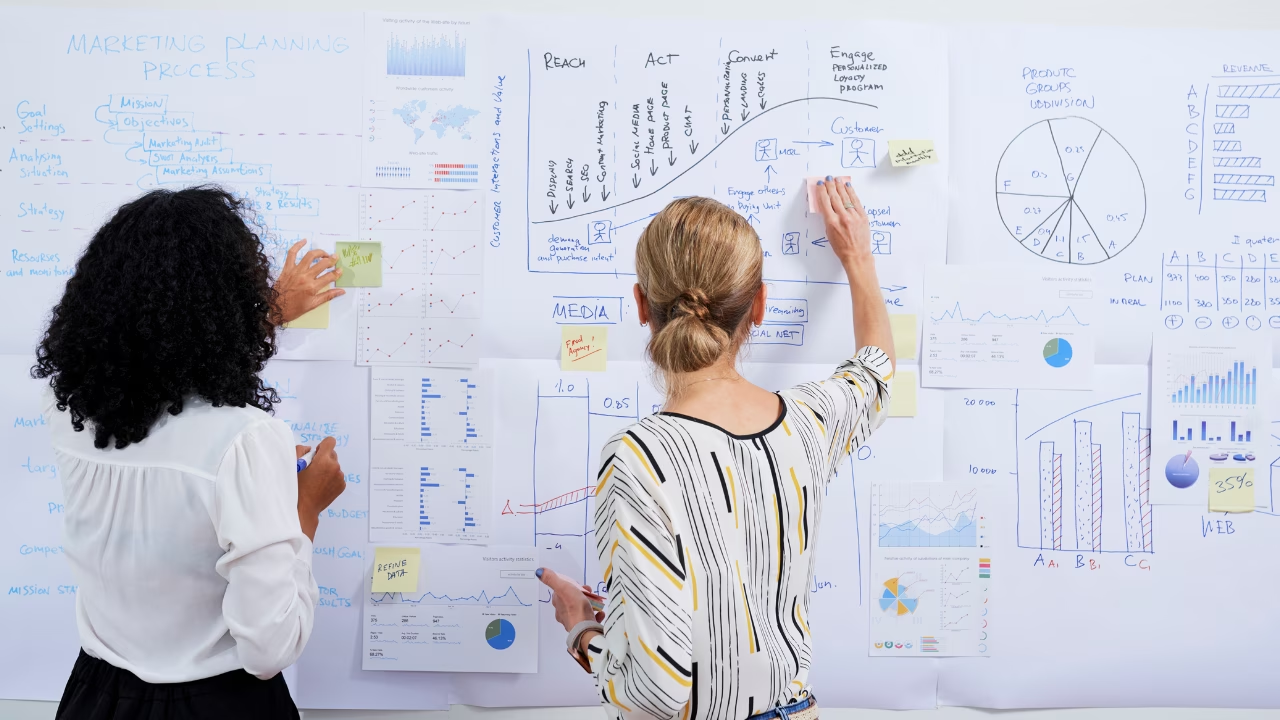

How to structure AI and human judgment for better anticipatory and strategic decisions

In this article:
- AI adoption in strategic foresight has crossed a tipping point, but results are uneven: Two-thirds of foresight practitioners now use AI in their work, according to a joint OECD and World Economic Forum survey of 167 experts across 55 countries, yet the most cited concern remains that AI-generated outputs tend toward the generic and contextually misaligned. (1)
- Most organizations are not getting those results, and the reason is architectural: General-purpose AI is trained on what is broadly popular in management discourse, not on what is strategically relevant to a specific organization. Without organizational context, AI produces recommendations that sound plausible but miss the competitive logic that makes strategy meaningful.
- The process works when AI and human judgment each do what they do best: AI excels at scanning at scale, clustering signals, and drafting first-pass analysis. Human experts add the scope definition, contextual validation, and strategic interpretation that turn those outputs into decisions. The handoffs between them must be deliberate and structured.
- Purpose-built foresight AI differs from general-purpose AI in significant ways. One key distinction is that purpose-built foresight AI systems, like Trendtracker, are specifically designed to align with an organization's competitive landscape and strategic priorities. These systems assign measurable indicators to each signal, including current strength, rate of change, and projected trajectory. Consequently, the insights generated are tailored to your organization, emphasizing what is strategically relevant rather than what may simply be broadly popular.
What is AI-Augmented Foresight?
AI-augmented strategic foresight is the structured integration of artificial intelligence into the foresight process to extend analytical reach without replacing the interpretive judgment that gives foresight its strategic value. Horizon scanning, trend analysis, scenario planning, and strategic monitoring remain the core of the discipline, AI changes the scale, speed, and coverage at which each can be performed, and improves the quality of the evidence base that feeds human deliberation.
The distinction that matters in practice is between AI as a research accelerator and AI as a strategic advisor. General-purpose models can do the former well and the latter poorly. A 2025 briefing from the European Parliament's Research Service concludes that while LLM-powered tools can augment efficiency and broaden analytical coverage, their value depends entirely on human expertise to define scope, validate outputs, and translate findings into decisions. (2) The technology accelerates the process; it does not substitute for the judgment at its center.
Why does it matter, and what does the evidence show?
The pressure to run foresight at greater speed and coverage has not eased. Planning horizons have compressed, and the sources of disruption (technological, social, geopolitical, environmental, and economic) have multiplied and become more interconnected. AI addresses several of these constraints simultaneously:
- Coverage at scale. AI can continuously monitor hundreds of millions of documents, extending horizon scanning far beyond what any team can sustain manually.
- Earlier access to weak signals. Detecting directional shifts before trends cross mainstream visibility gives foresight teams lead time that periodic manual scanning cannot provide.
- Reduced routine workload. Automating data collection and first-pass clustering frees analyst capacity for the interpretive and judgment-intensive work that generates strategic value.
- Richer scenario inputs. AI accelerates scenario narrative drafting and stress-tests assumptions, surfacing alternative storylines that challenge team consensus, subject to expert validation.
- Continuous monitoring between cycles. AI keeps key drivers under observation between planning cycles, flagging threshold changes before they become urgent.
There is compelling evidence that highlights these improvements. A 2025 academic study published on SSRN examined AI-human collaboration in a major global industrial company's foresight process and found approximately a 20% reduction in process duration, a 25% decrease in resource utilization, a 50% reduction in expert time on data-intensive tasks, and a 30% improvement in analytic quality, while the scope of analysis expanded simultaneously. (3)
An AI-Augmented Foresight workflow
In the realm of foresight, integrating AI is not without its challenges. A 2026 study published in the Harvard Business Review evaluated the performance of seven prominent AI assistants across different strategic scenarios. The findings highlighted a notable trend: these assistants frequently suggested similar strategies that aligned with popular themes, a phenomenon termed “strategy trendslop”. This underscores a critical distinction in the effectiveness of AI tools; while general-purpose models can generate widely accepted ideas, they often fail to account for the specific organizational context needed for truly meaningful insights (4).
To address this limitation, Trendtracker is a purpose-built strategic intelligence and foresight AI that provides both quantitative and qualitative insights tailored to specific industries and clients. On the quantitative side, it generates trend metrics finely tuned to each sector, helping understand the evolution of trends within specific industries. Meanwhile, on the qualitative side, Trendtracker emphasizes contextual relevance, ensuring its recommendations closely align with each organization's unique circumstances. By employing a customer context profile for every client, the platform captures critical elements such as the competitive landscape, strategic priorities, and key macro forces, creating a continuous intelligence layer. This bespoke approach allows for a tailored interpretation of every signal, trend, and implication through the distinctive lens of each industry and organization, empowering teams to extract actionable insights rather than get lost in generic advice.
An AI-augmented foresight process, coupled with the capabilities of Trendtracker:
Step 1: Define the strategic scope. Every foresight process begins with a frame: the time horizon, the domains that matter. This step is irreducibly human: AI has no basis for relevance filtering without a clearly defined scope and will return what is broadly interesting rather than strategically pertinent. The quality of everything that follows depends on this frame.
Trendtracker's team works with clients to frame and define their Customer Context, encoding strategic priorities and competitive landscape into the intelligence layer before any scanning begins, so scope definition becomes a permanent filter rather than a one-time prompt.
Step 2: Automated horizon scanning and signal detection. With the scope defined, AI enhances environmental scanning by monitoring sources and geographies that a manual team cannot continuously track. It identifies emerging signal clusters and directional shifts before trends become mainstream. For instance, a 2025 briefing from the European Parliament Research Service shows that LLM-augmented scanning systems achieve retrieval rates of about 95% for articles that a human analyst would have flagged, all while requiring significantly less manual effort.(2)
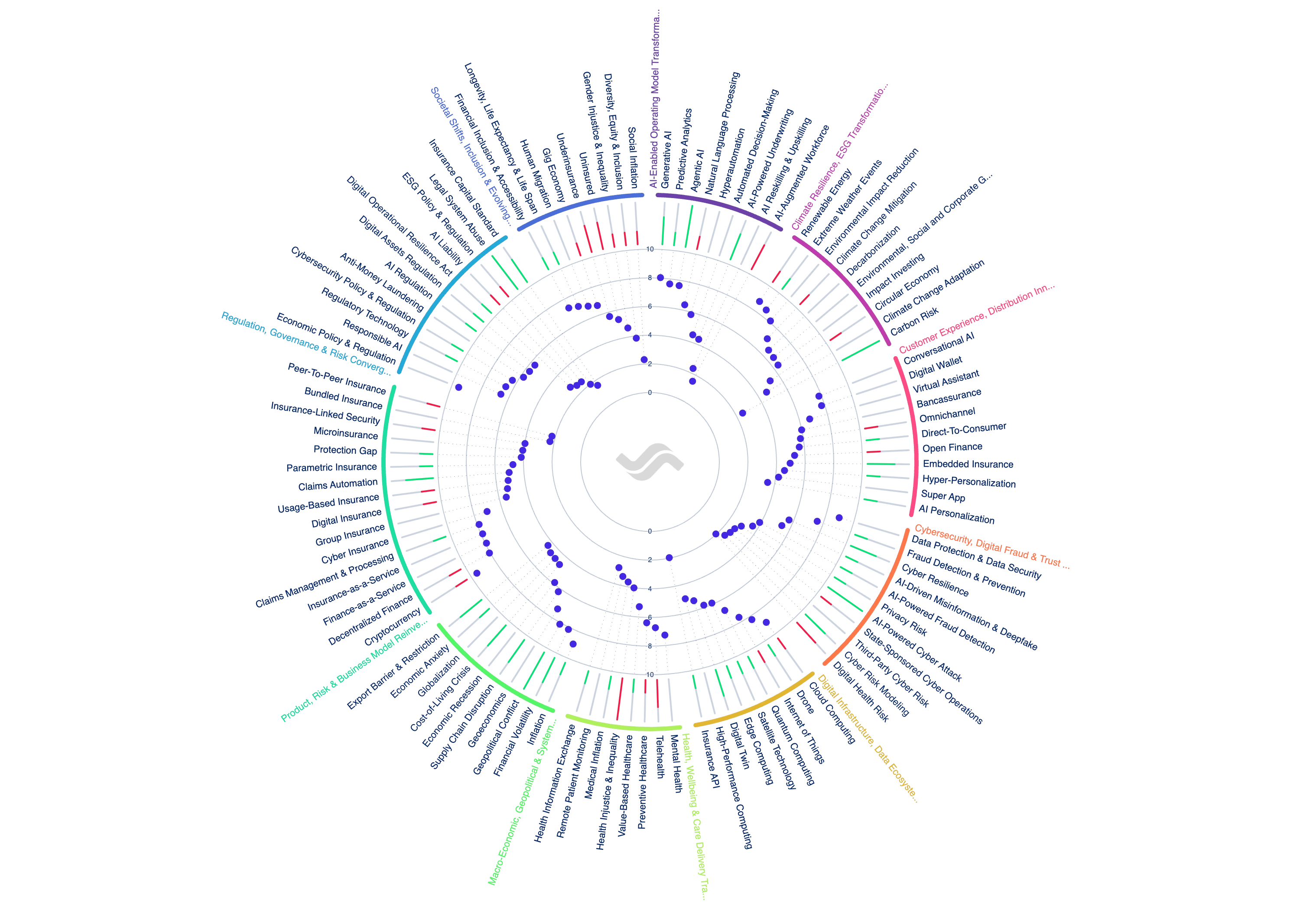
Trendtracker runs this continuously across 500 million documents and 20,000 curated sources, updated daily, not trained on a historical snapshot, keeping trends evolution visible between planning cycles at a coverage level no general-purpose tool can sustain.
Step 3: Signal prioritization and human validation. Not every signal requires strategic attention. AI can provide an initial screening based on factors such as the strength of the evidence and potential for growth. Meanwhile, humans provide valuable insights when evaluating relevance, novelty, and alignment with organizational goals. A survey conducted by the OECD and WEF highlights that the quality and trustworthiness of outputs are significant concerns among practitioners, making this validation step essential to ensure that the signals are meaningful for teams and decision-making. (1)
Trendtracker assigns quantitative indicators to each trend, measuring current strength, rate of change, and projected trajectory. Additionally, users can vote on the impact, level of uncertainty, and relevance of each trend for their organization. This approach allows for the prioritization of trends by combining human input with AI analysis within the platform.
Step 4: Scenario development. Prioritized trends inform the creation of scenarios, which are distinct and plausible future projections that help teams prepare for a wider range of possibilities. AI enhances the analytical process by drafting narratives, generating alternative combinations of driving factors, and revealing potential blind spots.
Trendtracker's Trend Insights translate signal movements into structured, context-specific evidence that feeds any scenario-building process, providing a grounded data foundation that makes resulting scenarios more defensible.
Step 5: Sense-making and implications. Scenarios are the frame for interpreting what each plausible future means for the organization, shifts in consumer behavior, products, and business models; emerging needs; and assumptions that no longer hold. This typically begins in live sessions where participants explore implications together. AI then expands the discussion, highlighting overlooked implications, introducing perspectives from adjacent domains, and challenging conclusions that form too quickly around familiar interpretations. The deliberation that follows is where teams develop ownership that makes conclusions executable. The real value lies in the strategic conversations prompted by the scenarios.
Trendtracker surfaces the organization’s context-specific implications, serving as a thinking partner during deliberation by expanding what the team considers and challenging conclusions that form too quickly. The resulting insights can then be organized into dedicated strategy, innovation, or risk workspaces within the platform, routing foresight outputs to the decision context where they create value.
Step 6: Continuous monitoring and signpost tracking. The foresight loop must be maintained between formal planning cycles. Organizations that build scenarios but stop monitoring the signals that would confirm or challenge them forfeit most of the exercise's anticipatory value. AI continuously reviews key drivers, flagging threshold changes for human escalation. The measure of a mature foresight process is the share of escalated signals traceable to a documented strategic decision.
-2.avif)
Trendtracker allows organizations to create customizable strategy signposts, identify innovation opportunities, and develop Risk Radars. These tools enable continuous monitoring of relevant signals, allowing organizations to track unfolding scenarios in real time. This proactive approach helps organizations make strategic decisions before changes fully materialize.
Conclusion
The case for AI in strategic foresight is well-established. Recent research shows that a well-designed AI-human workflow, with a clear division of labor, leads to better outcomes: AI handles data scale while human experts provide judgment. This combination makes foresight faster, broader, and more rigorous.
The challenge lies in bridging the gap between deploying AI tools and developing AI-augmented foresight intelligence. While deploying tools is straightforward, developing foresight intelligence requires a clear scope, organizational context, structured validation, and a feedback loop connecting signals to decisions. Tailored foresight intelligence, such as Trendtracker, aligned with the organization's competitive landscape and operational between planning cycles, is crucial for turning trends into actionable strategic outcomes.
References
- World Economic Forum & OECD. (2025). AI in Strategic Foresight: Reshaping Anticipatory Governance. WEF/OECD White Paper. https://www.weforum.org/publications/ai-in-strategic-foresight-reshaping-anticipatory-governance/
- Vesnic-Alujevic, L. with d'Ambrosio, S. (2025, July). Augmented foresight: The transformative power of generative AI for anticipatory governance. European Parliamentary Research Service Briefing, PE 774.665. https://www.europarl.europa.eu/thinktank/en/document/EPRS_BRI(2025)774665
- Rohrbeck, R., Szuppa, S., & Schmidt, J. (2025). Artificial Intelligence in Strategic Foresight: The case of Siemens Professional Education. SSRN Preprint (not yet peer reviewed). https://ssrn.com/abstract=5636869
- Researchers Asked LLMs for Strategic Advice. They Got “Trendslop” in Return. (2026, March 16). Harvard Business Review. https://hbr.org/2026/03/researchers-asked-llms-for-strategic-advice-they-got-trendslop-in-return