
Anticipatory Governance: How Public Governance Leaders Can Act on a Signal Before It Becomes a Crisis

- Anticipatory governance has been recognized as a discipline for decades. Many public organizations have some form of anticipatory practice, but few run it in a way that consistently reaches the decisions that hold real authority and budget.
- Policy often arrives late, and by the time it does, the damage is already systemic. Regulation tends to respond once the case for harm is no longer in dispute, not while it's still forming.
- The alternative is acting while the window is still open. A small number of governments are already legislating ahead of emerging harms rather than after them, proving the pattern isn't inevitable.
- Continuity is one of the core challenges. Horizon scanning and scenario building are well-understood techniques. One difficulty lies in sustaining them consistently across planning cycles, drawing on sufficiently diverse sources, and keeping pace with the speed modern policy environments demand.
Public governance faces sustained pressure to keep pace with rapidly evolving challenges, such as climate change, AI deployment, geopolitical shifts, and demographic transformation. These issues generate signals long before they force a policy response. The difficulty is rarely a total absence of information. Relevant signals exist, but they are dispersed across sources, arrive in different forms, and shift faster than most institutions can track through periodic reviews alone. By the time a coherent picture forms through traditional channels, much of the window for anticipatory action has already closed. That gap between first signal and undeniable case for action, is exactly what anticipatory governance exists to close.
What is Anticipatory Governance?
The OECD defines anticipatory governance as the systematic practice of embedding foresight, experimentation, and innovation into the policymaking process, so that emerging issues are identified and addressed while response options remain open (1). The concept has roots in science and technology studies, where researchers examined how governments could engage with new technologies upstream of their consequences rather than downstream of them (2).
The reason timing matters comes down to a dynamic, most governance leaders recognize. A weak signal detected early can be explored, weighed against options, and built into a strategy that is adjusted as evidence develops, all while the issue remains manageable and costs are low. The same signal, left until it surfaces through traditional channels, tends to arrive as a news story, then political pressure, then a scramble to contain damage that has already accumulated (3). The signal is identical in both cases. What differs is when the institution moves.
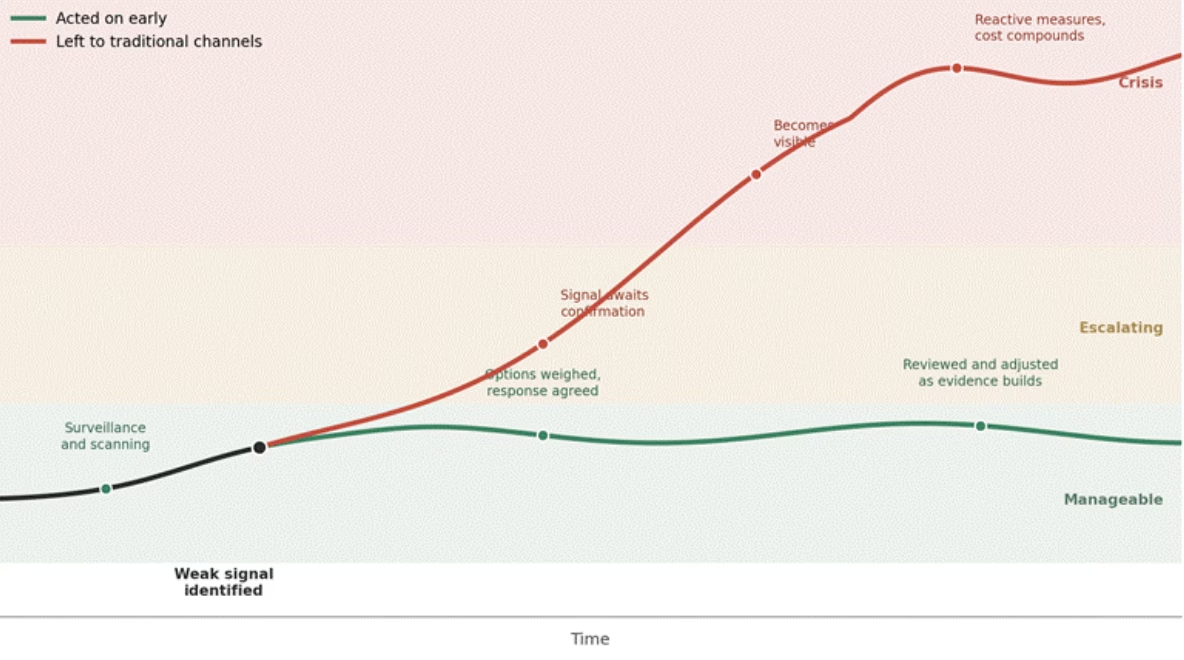
One example is the UK ban on social media use for individuals under 16, announced in June 2026. Evidence regarding the harms posed to young users has been accumulating for nearly a decade through academic research, regulatory inquiries, and parliamentary committees. However, it wasn't until the cost of inaction became politically impossible to overlook that a binding response was implemented. Initially, the policy stalled when the issue first emerged, but it ultimately moved forward under mounting pressure.
In practice, anticipatory governance requires three things working together:
- Spotting change early: through ongoing scanning, not a one-off study
- Testing responses while they're still cheap: small experiments before big commitments
- Turning what's learned into actual policy: so the insight doesn't stop at a slide deck
It also has to function as a standing institutional capability. Anticipatory work that depends on specific champions and people's capabilities tends to disappear when those champions and people leave. It needs to be developed as an organizational capability, with processes and tools that persist across electoral cycles and administration changes, and that are legible enough for oversight bodies to see that its purpose is clear and defensible (1).
Why does it matter now?
The case for anticipatory governance is based on two key points: the recurring costs of delayed action and the proven benefits of maintaining this capability over time.
On the cost side, a similar pattern emerges across diverse domains. For example, prior to the 2008 financial crisis, financial innovation was viewed favorably, and regulation was minimal. The risks accumulating beneath the surface went largely unaddressed until the crisis became undeniable. Regulations were implemented only after their effects had pervaded the financial system. A similar late-response pattern occurred less than a decade later concerning social media's influence on election interference and public trust, in a different domain, with the same delayed response (7). In both instances, individual signals were present, but what was lacking was a continuous process to connect these signals, explore various potential outcomes, and provide policymakers with a cohesive understanding to act on before the opportunity for action had passed.
This dynamic is also evident in AI governance, which is currently unfolding in real time. Emerging technologies progress through their development cycles more rapidly than regulatory processes can keep up. The practical outcome, as highlighted by the OECD's 2024 framework for the anticipatory governance of emerging technologies and independent regulatory studies, is that by the time the effects of a technology are well understood, the opportunity to influence its direction has often significantly diminished (5). Denmark serves as a counterexample, having proposed in 2025 that individuals be granted legal ownership of their own faces and voices before AI-generated deepfakes caused the widespread harm that typically prompts governmental reactive measures (8).
This is where continuous organizational process matters. A periodic report can only show what was already visible by the time someone compiled it, useful the day it lands, already behind soon after. What decision-makers need is a picture that keeps updating as conditions shift, so a judgment made on this quarter's evidence doesn't quietly go out of date by the time anyone acts on it. The decision, the mandate, and the accountability for it stay with the institution and the people leading it. What changes is whether the picture in front of them is current or already behind.
Where this capability has been established and maintained, the benefits are evident. The OECD's 2025 guidelines identify five recurring benefits for institutions that have integrated anticipatory governance: future-readiness, innovation, endurance, long-term perspective, and direction (1). These institutions share a structural advantage: the practice is ingrained in their operational processes, ensuring its continuation even amidst changes in government. A one-time foresight exercise depends heavily on the individual leading it at the time. A standing capability is built to endure through its structures and processes, so it persists regardless of leadership changes.
The remaining challenge for most institutions is how to develop and maintain this capability across electoral cycles, and what role intelligence infrastructure plays in ensuring its sustainability in actual operational conditions.
How to build the capability?
Developing a functional capacity for anticipatory governance involves the simultaneous coordination of several institutional pillars. According to the OECD's 2025 framework, the primary enabling factors include a clear mandate from leadership, continuous monitoring infrastructure, and integrated cross-departmental structures, all supported by the professional competencies required to transform foresight into actionable policy (1). The following sequence outlines how these high-level principles are operationalized into practice, with each step paired with how Trendtracker supports it.
1. Define the scanning mandate. The first decision is scope: which policy domains, time horizons, and signal types the institution needs to track. Scanning without a defined mandate produces sheer volume. The signals most likely to inform real decisions are also the ones most likely to get lost inside it (1).
Trendtracker's Customer Context encodes the institution's mandate, policy domains, key stakeholders, and the macroforces most relevant to its environment, with Trend Boards configured by region and domain so every signal surfaced reflects what the institution is actually responsible for.
2. Scan continuously, across the full range of sources. Signals that eventually shape policy rarely surface first in mainstream channels. An emerging regulatory issue typically appears in academic literature, patent activity, or investment flows well before it reaches the news, which means breadth of source coverage and monitoring frequency matter more than depth on familiar sources (1, 5). A 2025 European Parliament briefing on generative AI in foresight found that AI-augmented scanning matched roughly 95% of the articles a human analyst would have flagged, while requiring far less manual effort (9).
Trendtracker continuously monitors over 500 million documents across 20,000+ sources, academic research, patents, investment activity, regulatory filings, industry news, consumer trends, macro forces, and press, so coverage stays live between planning cycles as well as during them.
3. Prioritize the signals worth attention. Continuous monitoring generates more signals than any institution can act on. Effective prioritization evaluates each signal for strength, momentum, and scope, distinguishing what is evidence-backed and growing from what remains nascent or localized, and identifies where signals from different domains are converging into a pattern that carries more policy significance than any single signal alone (1).
Trendtracker assigns measurable indicators to each signal, current strength, rate of change, and projected trajectory, and teams can layer in a structured stakeholder survey to weigh impact, uncertainty, and relevance, combining external trend evidence with internal judgment.
4. Build scenarios to explore plausible futures. Prioritized signals become the raw material for scenario building, the step that bridges intelligence gathering and policy design (1, 4). The goal is a small set of distinct futures that reveal which policy choices hold up across conditions and which only work if the world behaves in one particular way. The wind-tunneling technique, for instance, helps test existing policy proposals against scenario narratives to identify where they need modification.
For each shortlisted driver, Trendtracker's AI Analyst generates multiple development paths, plausible ways the driver could evolve, which feed directly into scenario construction. Once scenarios are built, signpost triggers are set and monitored continuously, keeping scenario assumptions current as the environment evolves.
5. Test responses before committing. A scenario that reveals a policy gap is useful; a tested response is more useful. The OECD identifies experimentation, through sandboxes, testbeds, and pilot regulation, as a core practice: testing governance innovations under real conditions before scaling them (1). Regulatory sandboxes have become an established tool across jurisdictions. The UK's Financial Conduct Authority pioneered the model in 2016. Singapore went further the same year: its Committee on the Future Economy embedded a "never say no" default into how regulators treat new business models, a culture that has since produced sandboxes spanning fintech, energy, and autonomous vehicles (7). The EU's AI Act now embeds the same logic directly into AI regulation, with sandboxes explicitly designed to generate regulatory learning that feeds back into policy before full commitment (6).
Trendtracker provides the evidence layer that makes experimental design more targeted. Every prioritized signal traces back to underlying documents, research papers, regulatory filings, and news sources, so the assumptions behind an experiment are auditable, and the signals that would confirm or challenge its findings are already under continuous review.

6. Monitor what was decided, and keep the loop running. Early-signal decisions hold up only if the assumptions behind them are tracked as conditions evolve. The OECD identifies continuous monitoring as a structural requirement for mature anticipatory governance, the difference between a one-off foresight exercise and a standing capability (1).
Trendtracker keeps priority areas and policy signposts under continuous review. When trend momentum shifts or new signals converge on a monitored domain, the change surfaces immediately, without waiting for the next planning cycle.
The cycle then starts again. Signals that did not warrant attention in one cycle may have moved by the next, and new ones will have emerged. Anticipatory governance is the discipline of keeping that loop running, cycle after cycle.
The decision at every stage belongs to the people with the mandate, the judgment, and the accountability for it. What changes with the right infrastructure is what those people have in front of them: a current, prioritized, traceable view of what is moving across the domains that matter to their institution. That same picture extends across departments through Trendtracker Shared Trend Boards, giving every team working a related domain one continuously updated view to work from, the practical form the OECD's call for integrated cross-departmental structures takes.
Conclusion
Anticipatory governance is the practice of connecting early signals across domains and acting on them before they harden into a crisis that leaves little room to choose how to respond. The risks institutions face today rarely arrive one at a time: geopolitical shifts, emerging technology, environmental pressure, and domestic political change increasingly move in parallel (10). That's exactly the setting where signals get missed, available individually, never read together.
Most institutions already have plenty of information. What they're missing is a way to see it whole, keep it current, and present it to the right people before the moment for action passes. That's the role intelligence infrastructure plays: it keeps the picture connected and up to date. The decision, the judgment, and the accountability stay with the institution and the people who run it.
For public governance leaders, that makes a difference between shaping an issue while it's still manageable and managing the consequences once it isn't.
Trendtracker works with public sector organisations to operationalize this kind of continuous intelligence infrastructure, from mandate definition through to signpost monitoring. Explore Trendtracker's public sector capabilities.
References
(1) OECD (2025). Towards Anticipatory Governance Guidelines for Public Sector Organisations. OECD Working Papers on Public Governance, No. 82. OECD Publishing, Paris.
(2) Guston, D. H. (2014). Understanding 'anticipatory governance.' Social Studies of Science, 44(2), 218–242.
(3) Dator, J. (2018). Emerging Issues Analysis: Because of Graham Molitor. World Futures Review, 10(1).
(4) European Institute of Public Administration (2025). Navigating Strategic Foresight in Public Administrations: The Do's and Don'ts. EIPA.
(5) OECD (2024). Framework for the Anticipatory Governance of Emerging Technologies. OECD Publishing, Paris.
(6) Ahern, D. (2025). The New Anticipatory Governance Culture for Innovation: Regulatory Foresight, Regulatory Experimentation and Regulatory Learning. European Business Organization Law Review, 26, 241–283.
(7) Armstrong, H., Gorst, C., & Rae, J. (2019, March). Renewing Regulation: 'Anticipatory Regulation' in an Age of Disruption. Nesta.
(8) European Parliamentary Research Service (2026, January 14). The Danish Approach to Copyright and Deepfakes: A Model for the EU? European Parliament.
(9) Vesnic-Alujevic, L. with d'Ambrosio, S. (2025, July). Augmented Foresight: The Transformative Power of Generative AI for Anticipatory Governance. European Parliamentary Research Service Briefing, PE 774.665.
(10) Muggah, R. (2025, March 10). What is anticipatory governance, and can it help us today? World Economic Forum.