
The Enterprise Guide to Horizon Scanning: Definition, Methods and Tools

In this article:
- Why horizon scanning is distinct from trend analysis, and why the difference matters for enterprise teams
- The three structural failure modes that make manual scanning inadequate at scale
- The five core methods used by strategy, risk, and foresight teams in practice
- How to evaluate horizon scanning software built for enterprise use
- How Trendtracker powers always-on horizon scanning across 20,000+ curated sources and 500 million documents
Strategic decisions made in 2026 are being shaped by signals that first appeared two or three years ago. The question is whether your team saw them, and whether the tools and processes you have in place were designed to surface them before they became unavoidable.
That is the problem horizon scanning was built to solve. Not as a methodology reserved for government agencies or academic futures institutes, but as a continuous, structured discipline that enterprise strategy, risk, and foresight teams increasingly treat as foundational to how they operate.
This guide covers what horizon scanning is, how it works in practice, which methods matter most for large organisations, and what to look for when evaluating horizon scanning software built for enterprise use.
What Is Horizon Scanning?
Horizon scanning is the systematic process of detecting early signals of potentially significant developments across technology, regulation, markets, geopolitics, and society before those developments reach mainstream awareness or show up in analyst reports.
The OECD defines it as a technique for identifying emerging issues, opportunities, and threats through the capture and interpretation of weak signals of potentially high-impact developments. Critically, the OECD's 2026 working paper on technology horizon scanning distinguishes the practice from conventional trend analysis: where trend analysis extrapolates from what is already known, horizon scanning explores areas of potential importance that have not yet fully materialised. It deals, inherently, with uncertainty rather than extrapolation [1].
Trend analysis answers "where is this going?" Horizon scanning answers "what are we not yet seeing?"
Both are necessary. But only one of them can surface a risk or opportunity before your competitors, your board, or the next planning cycle catches up to it.
Horizon scanning is not a single tool or output. It is a discipline, a set of structured practices for continuous external monitoring, that feeds directly into strategic planning, risk management, and innovation decisions when done well. Done manually or in isolation, it is slow, inconsistent, and limited by the bandwidth and biases of the people doing it.
Why Enterprises Need Horizon Scanning Now
The case is not about access to data. Most large organisations already have access to broadly comparable information. The case is structural: most enterprises are still operating intelligence workflows that were designed for a slower, more predictable external environment. Those workflows have three specific failure modes.
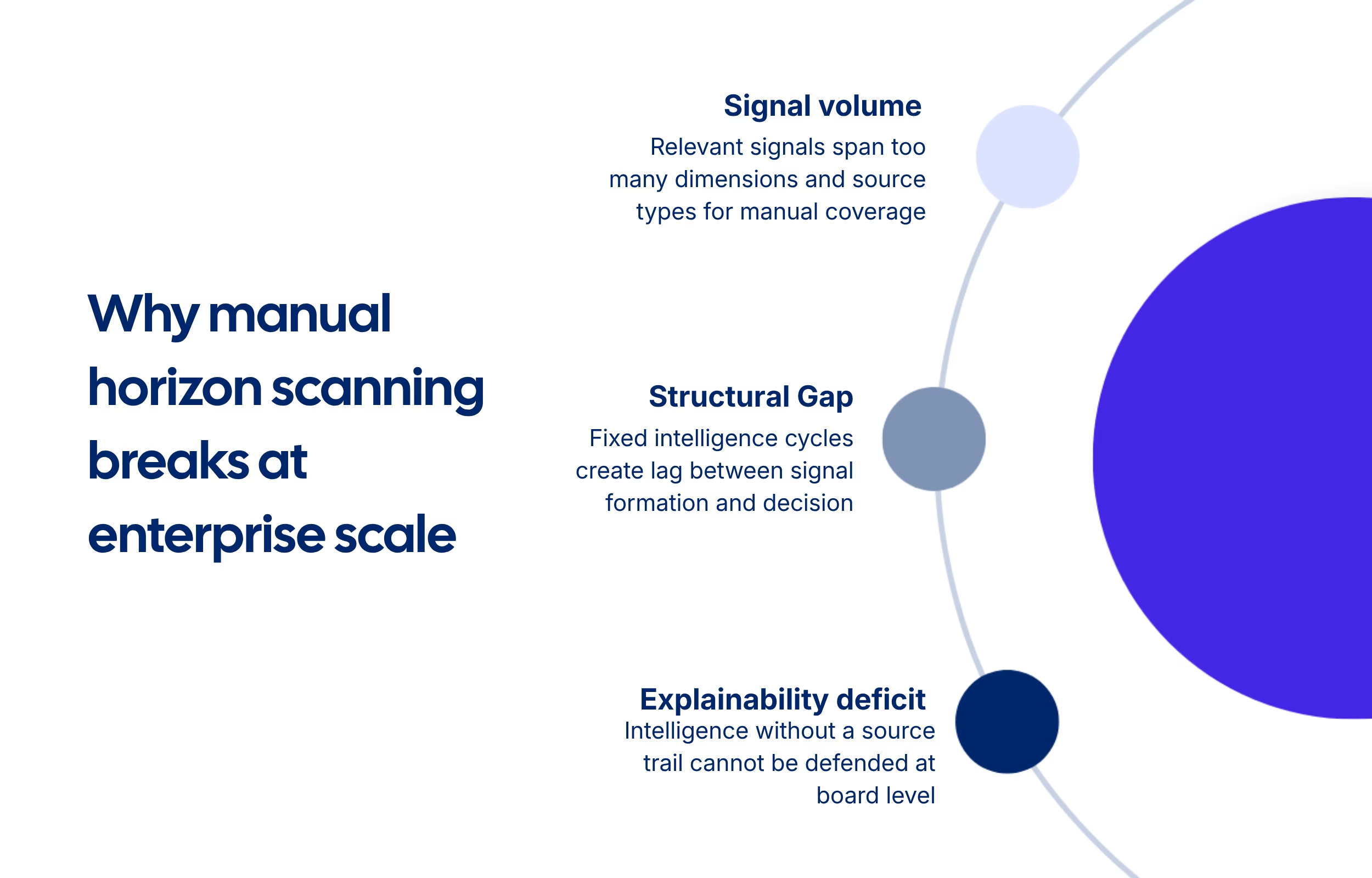
Failure mode one: signal volume no team can cover manually
The external environment an enterprise needs to monitor today spans regulatory developments across multiple jurisdictions, technological disruptions emerging from patent filings and academic research, macroeconomic signals, geopolitical shifts, competitive moves, and changes in consumer and market behaviour. Each of these dimensions moves at a different pace and surfaces through different source types.
No analyst team, however experienced, can cover that landscape manually without introducing gaps, delays, and blind spots. The signals that matter most are often the weakest ones: early-stage regulatory proposals, nascent technology research, early startup activity in adjacent spaces. By the time they consolidate into a mainstream report or a consultant deck, the window for proactive response has frequently already narrowed.
BCG Henderson Institute research into strategic foresight capabilities consistently finds a substantial performance gap between organisations that practise foresight systematically and those that do not - across profitability, revenue growth, and strategic resilience over multi-year periods [2]. The gap is not explained by access to information. It is explained by the practices and infrastructure that determine whether signals are spotted early enough to act on.
Failure mode two: the structural gap between signal and decision
Most large organisations still rely on a combination of periodic intelligence cycles, static analyst reports, and informal monitoring by individual team members. This creates a structural gap between when a signal emerges in the external environment and when it reaches the right decision-maker. That gap, not a shortage of data, is what horizon scanning addresses.
"We are in an era characterised by rapid change, complexity, uncertainty, and more frequent global economic shocks... horizon scanning techniques can provide valuable insights by enabling practitioners to understand the dynamics of change around longer-term trends." [3] - Bank of England Independent Evaluation Office, June 2025
Failure mode three: explainability that generic AI cannot provide
This is the one most organisations underestimate. Generic AI tools can generate summaries and surface patterns quickly. What they cannot do is explain where a signal came from, how its strength has changed over time, or whether it is validated by multiple independent source types. There is no audit trail, only a plausible-looking answer.
For strategy and risk functions where decisions need to be defensible to boards and regulators, that is not a minor limitation. It is a structural disqualifier. When a Chief Risk Officer presents an emerging threat to the audit committee, or a Head of Strategy takes a market positioning recommendation to the board, the underlying intelligence needs to be traceable, back to the patent filings, regulatory consultations, investment activity, and research publications that justify it. A summarised output from a language model cannot provide that chain.
Horizon scanning infrastructure built for enterprise use must therefore combine signal detection with source traceability and scoring. The question is not only whether a signal exists, but whether it can be defended.
The Core Methods of Horizon Scanning
Horizon scanning is not a single method. In practice, enterprise teams draw on several complementary approaches, often in combination.
PESTEL signal monitoring
The most structured approach organises scanning across the six dimensions of the PESTEL framework: Political, Economic, Social, Technological, Environmental, and Legal. Each dimension requires different source types and different cadences. Regulatory signals emerge from policy publications, consultation documents, and parliamentary proceedings. Technological signals emerge from academic research, patent filings, and startup investment activity. Organising monitoring by PESTEL dimension ensures systematic coverage rather than reactive attention to whichever signals happen to be most visible.
Weak signal detection
The highest-value output of horizon scanning is often the identification of weak signals: early-stage, low-visibility developments that carry disproportionate future implications. Weak signals are, by definition, easy to miss in a noisy environment. Detecting them requires both broad source coverage and a methodology for distinguishing genuinely emergent developments from noise. This is an area where AI-enabled horizon scanning software provides a significant advantage over manual approaches. The pattern recognition required to surface weak signals at scale across thousands of sources is not practically achievable by human teams alone.
Trend radar mapping
Once signals have been identified and validated, trend radar mapping provides a visual structure for communicating maturity and velocity to leadership teams. A well-constructed trend radar distinguishes between signals at different stages of development, emergent, growing, maturing, and indicates the direction of travel. This moves horizon scanning output from raw intelligence into decision-ready format. For more on how AI-powered trend radars work in practice, see How Trendtracker's Trend Radar automates continuous scanning.
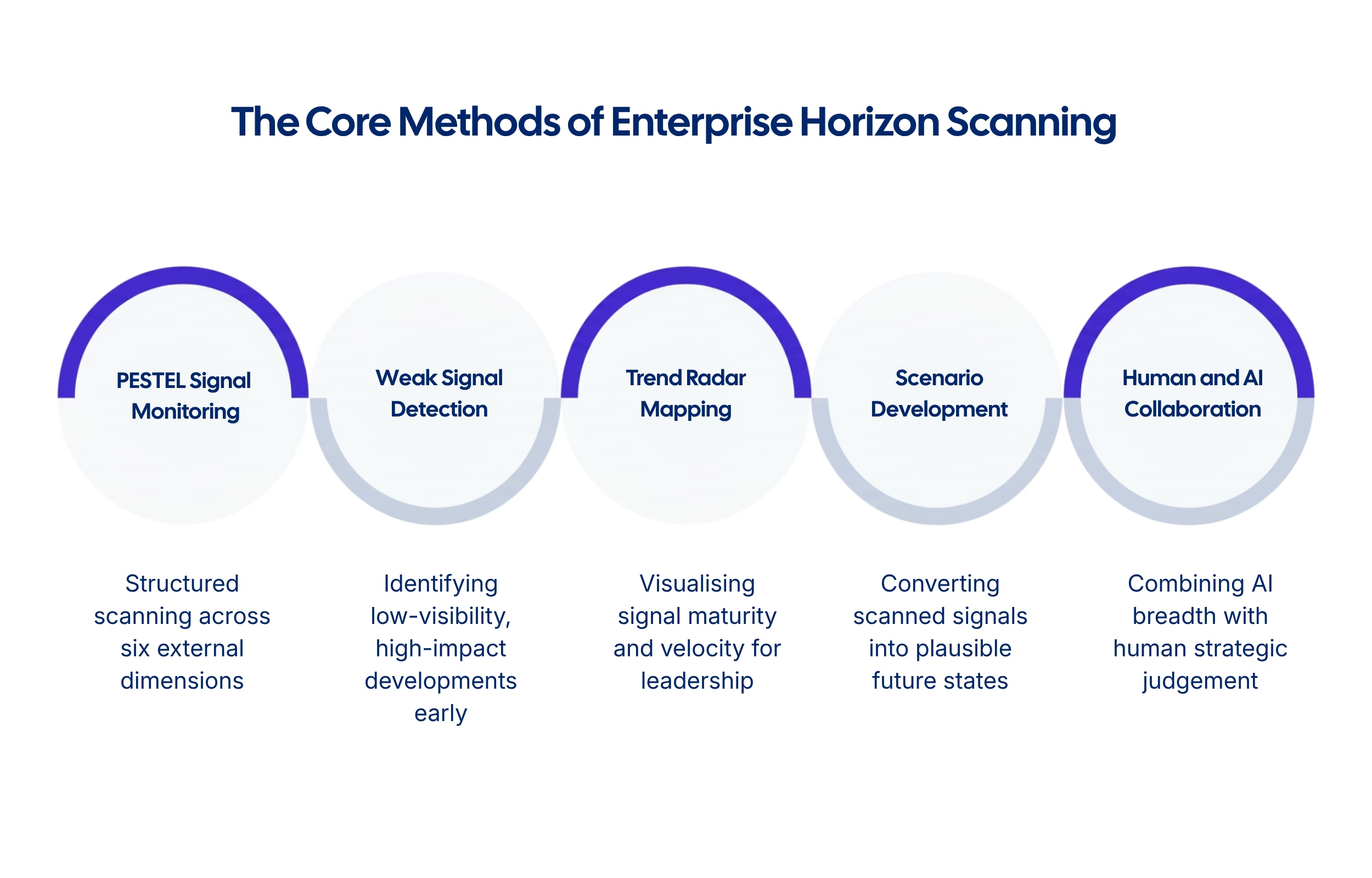
Scenario development
Horizon scanning feeds scenario planning by providing the raw material for credible alternative futures. Where trend analysis produces a single most-likely trajectory, scenario development uses scanned signals to construct a range of plausible outcomes across different combinations of uncertainty. This is particularly valuable for strategy and risk teams who need to stress-test existing plans against external developments they cannot predict with certainty. For a deeper look at the types of scenario planning enterprises use, see The 5 Types of Scenario Planning for Businesses.
Human and AI collaboration
Effective horizon scanning combines the breadth and speed of AI-enabled monitoring with human judgement about relevance, context, and strategic implication. AI does the heavy lifting of continuous source monitoring, signal detection, and scoring. Human analysts steer the objectives, interpret the output, and translate signals into strategic recommendations. The discipline works best when neither replaces the other. For how this model applies to strategic foresight more broadly, see How to Develop Strategic Foresight Through Environmental Scanning.
Who Owns Horizon Scanning in Large Organisations
Horizon scanning does not belong to a single function, and in organisations where it works well, it rarely does. In practice, ownership sits across several teams, each with a distinct purpose for the intelligence it produces.
Strategy and foresight teams use horizon scanning to maintain a continuously updated view of the external landscape, validate strategic assumptions, and bring evidence-based foresight into the annual and multi-year planning process. For large organisations in insurance, banking, and FMCG, industries where long-cycle decisions are made against a rapidly shifting external backdrop, this is often where the horizon scanning mandate is most formal.
Risk teams use it as an early warning system for emerging external risks that do not yet appear in a risk register. Regulatory change, geopolitical shifts, and technology-driven disruption are the categories most often cited. The goal is not to replace existing risk frameworks but to extend their reach into the pre-crystallised phase of risk development.
Innovation teams use horizon scanning to identify technologies and market signals worth investigating before they reach mainstream adoption, and to filter out the noise of overhyped trends that do not yet have the momentum to justify investment.
What unites these use cases is a common dependency: the quality of the intelligence layer underneath. Whether the output feeds a strategy brief, a risk register, or an innovation pipeline, the upstream question is the same. Are the right signals being captured, continuously, from the right sources, with sufficient structure to be acted on?
See how Trendtracker supports Strategic Foresight and Planning and Risk Management use cases.
What to Look for in Horizon Scanning Software
The category of tools described as horizon scanning software is broad and inconsistently defined. Some were built for competitive intelligence distribution. Others for innovation pipeline management. Others are general-purpose AI tools repurposed for foresight tasks.
As Trendtracker's platform comparisons page notes, the landscape is fragmented because many tools were designed for fundamentally different jobs. Some are built to organise what you already know, not monitor what you do not know yet. Others are optimised for the present rather than for forward-looking signal detection. Others respond to questions you already know to ask, rather than surfacing signals you had not thought to look for.
A tool that delivers a report when you ask for one is not a horizon scanning tool. It is a search assistant.
With that distinction in mind, enterprise teams evaluating horizon scanning software should assess against the following criteria.
Continuous monitoring, not periodic research. Horizon scanning software should be monitoring its source landscape continuously and surfacing new signals as they emerge, not when queried.
Source breadth and curation quality. Patent filings, academic research, regulatory publications, investment activity, and industry-specific content each surface different types of signals. A tool drawing only from news and social media will systematically miss the upstream signals that precede public coverage. Curation quality matters as much as volume: a large corpus of low-quality sources produces noise, not intelligence.
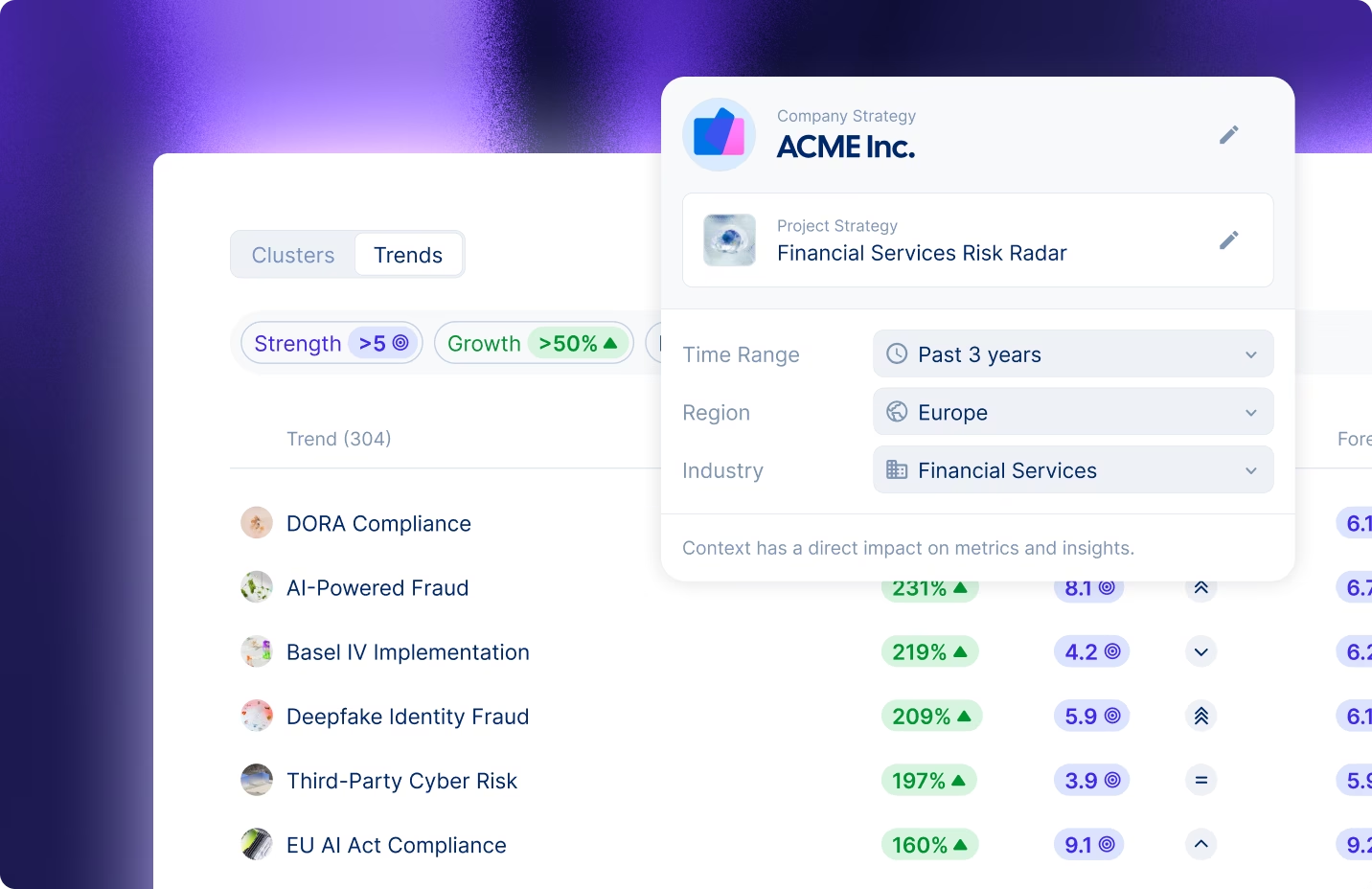
Trend scoring and prioritisation. Signal identification is only the first step. Without a mechanism for scoring by strength, velocity, and strategic relevance, teams face the same problem they had before: too much undifferentiated information, and no principled basis for deciding where to focus.
Configurability to strategic context. Generic intelligence has limited value for enterprise strategy teams. The output needs to be shaped by the organisation's specific strategic context: the industries it operates in, the geographies that matter, the initiatives it is running, and the risks it is tracking.
Explainability and source traceability. For decisions that need to be defensible to boards, regulators, or executive committees, every insight needs a traceable source chain - back to the underlying patent filings, regulatory consultations, investment rounds, and research publications. This is a governance requirement, not a feature preference. Generic AI tools currently cannot satisfy it: they generate outputs, but they cannot provide receipts.
Collaboration and sharing for cross-functional use. Horizon scanning output that lives in a single analyst's workflow does not function as organisational intelligence. The software layer needs to support shared workspaces, configurable access, and output formats ready to use across strategy, risk, and innovation functions without reconstruction.
How Trendtracker Powers Enterprise Horizon Scanning
The three failure modes described above, signal volume, the structural gap between signal and decision, and the explainability deficit, map directly to what Trendtracker was built to solve.
On signal volume. Trendtracker continuously monitors 20,000+ curated sources spanning approximately 500 million documents across academic research, patent filings, regulatory publications, news, and industry content. The emphasis is on curation over aggregation: sources are selected and maintained for relevance and reliability, not simply indexed for coverage. The result is breadth without noise.
On the structural gap. Rather than surfacing a generic feed and leaving interpretation to the analyst, Trendtracker scores every trend on a proprietary 0-10 scale using a rolling 12-month model that measures momentum across source types - academic research, patent activity, investment flows, industry publications, and more. Scores are updated monthly and are traceable to the underlying proof points behind them. A trend with a rising score is not an editorial judgement. It is a measurable shift in activity across multiple independent source types. That is what moves intelligence from the analyst's inbox to the planning room.
On explainability. Every insight on the platform links back to its source chain. The evidence that supports a trend score, the specific deals, filings, publications, and investment rounds, is accessible behind every output. This is what makes Trendtracker's intelligence defensible in a board presentation or a risk committee review, rather than merely plausible. It is the difference between intelligence and opinion.
Context-configured from the start. Trendtracker configures intelligence to each organisation's strategic context at onboarding: the industries, geographies, initiatives, and risk priorities that shape what the platform surfaces. Teams do not receive a broad stream and filter it down. They receive a view that is immediately relevant to their decisions.
"The world is changing fast, but Trendtracker cuts through the complexity with AI-powered and human-scored trends to sharpen our decisions." - Hans de Cuyper, CEO, Ageas
Trendtracker is trusted by strategy and foresight teams at Zurich Insurance, PepsiCo, Siemens, BNP Paribas, and the Geneva Association, among others.
Horizon scanning is a discipline. The right software makes it continuous.
The organisations that consistently anticipate rather than react are not doing so because they have access to better data. They are doing so because they have built the infrastructure to monitor, score, and act on signals before those signals become decisions forced on them by circumstance.
Horizon scanning, practised continuously and supported by the right platform, is how that infrastructure gets built. The question for most enterprise teams is no longer whether to invest in it. It is whether their current tools and processes are designed to support it at the scale, speed, and evidential rigour their organisation actually requires.
References
[1] OECD (2026). Building Capacity in Technology Horizon Scanning. OECD Working Paper. https://www.oecd.org/en/publications/building-capacity-in-technology-horizon-scanning_b4f0d383-en.html
[2] BCG Henderson Institute. What Companies That Excel at Strategic Foresight Do Differently. BCG Henderson Institute. https://bcghendersoninstitute.com/what-companies-that-excel-at-strategic-foresight-do-differently/
[3] Bank of England Independent Evaluation Office (2025, June). IEO Horizon Scanning Evaluation: Bank Response.https://www.bankofengland.co.uk/independent-evaluation-office/ieo-report-june-2025/ieo-horizon-scanning-evaluation-bank-response