
Weak Signal Detection: How Enterprise Teams Spot Change Before It Becomes a Trend
- Weak signals are early, easy to miss, and often important. They are fragments of evidence that something may be changing. Noise and existing assumptions make them easy to overlook.
- Extrapolating known trends isn’t enough. A recent global study found that a handful of weak signals act as hubs, speeding up change across many others.
- Detection works as a six-step cycle. Scan widely, profile each signal, look for patterns, map how signals affect each other, test cheaply, and make sure signals reach decision-makers.
- Software widens the scan. People still decide. AI-powered monitoring reads far more sources than a team can and keeps signals in view between planning cycles. What a signal means, and what to do about it, is a human call.
Most Enterprises are good at tracking trends that are already visible. Far fewer can reliably catch what comes before them: scattered, ambiguous evidence that something has started to shift. By the time a development reaches industry reports, everyone else has read the same reports, and the chance to move early is mostly gone.
Part of the problem is that early evidence rarely looks important. It arrives in fragments, often from sources nobody on the team reads, and it tends to contradict what the organization already believes. So it gets filtered out, usually by the same habits that stop people from drowning in information.
What are weak signals?
A weak signal is the first indicator of a change or emerging issue that may become significant in the future (1). Igor Ansoff, who introduced the term, saw weak signals as early, imprecise symptoms of problems ahead (2). “Weak” refers to how visible a signal is, not how much it matters. Weak signals get lost because they’re buried in noise and because they challenge the assumptions people use to decide what’s relevant (2).
What’s the difference between weak signals, trends and wild cards?
Weak signals are easily confused with two neighboring ideas, trends and wild cards. The table below sets out how they differ. The labels do get mixed up in practice, and some researchers have even used “wild card” and “weak signal” as synonyms (3).
Weak signal
What it is: Early, ambiguous evidence of a change that may matter later (1)
Certainty: Low; it may grow, or simply fade (3)
Timing: Still needs time to mature (1)
How it relates to the others: Can grow into a trend or megatrend, or come before a wild card (3)
Trend
What it is: A development already clearly visible in the present (1)
Certainty: Higher, its consequences can be studied and prepared for (1)
Timing: Already under way (1)
How it relates to the others: Often grew out of earlier weak signals (3)
Wild card
What it is: A sudden, surprising event (1, 3)
Certainty: Low probability, high impact (3)
Timing: Happens quickly (3)
How it relates to the others: May have been preceded by weak signals (1)
What is weak signal detection?
Weak signal detection is the practice of finding weak signals, deciding which deserve attention, and working out what they could mean for the organization. It’s part of horizon scanning and adds to trend analysis by looking at the earliest, least certain developments (1).
Different teams use it for different reasons, often while looking at the same evidence. Imagine a scattering of early reports about small firms letting AI agents make routine customer decisions. A strategy team would ask whether that changes how its market competes. An innovation team would look for something to build. For a foresight team, the question is which scenario it strengthens, while the risk team wants to know what happens when one of those agents gets a decision wrong.
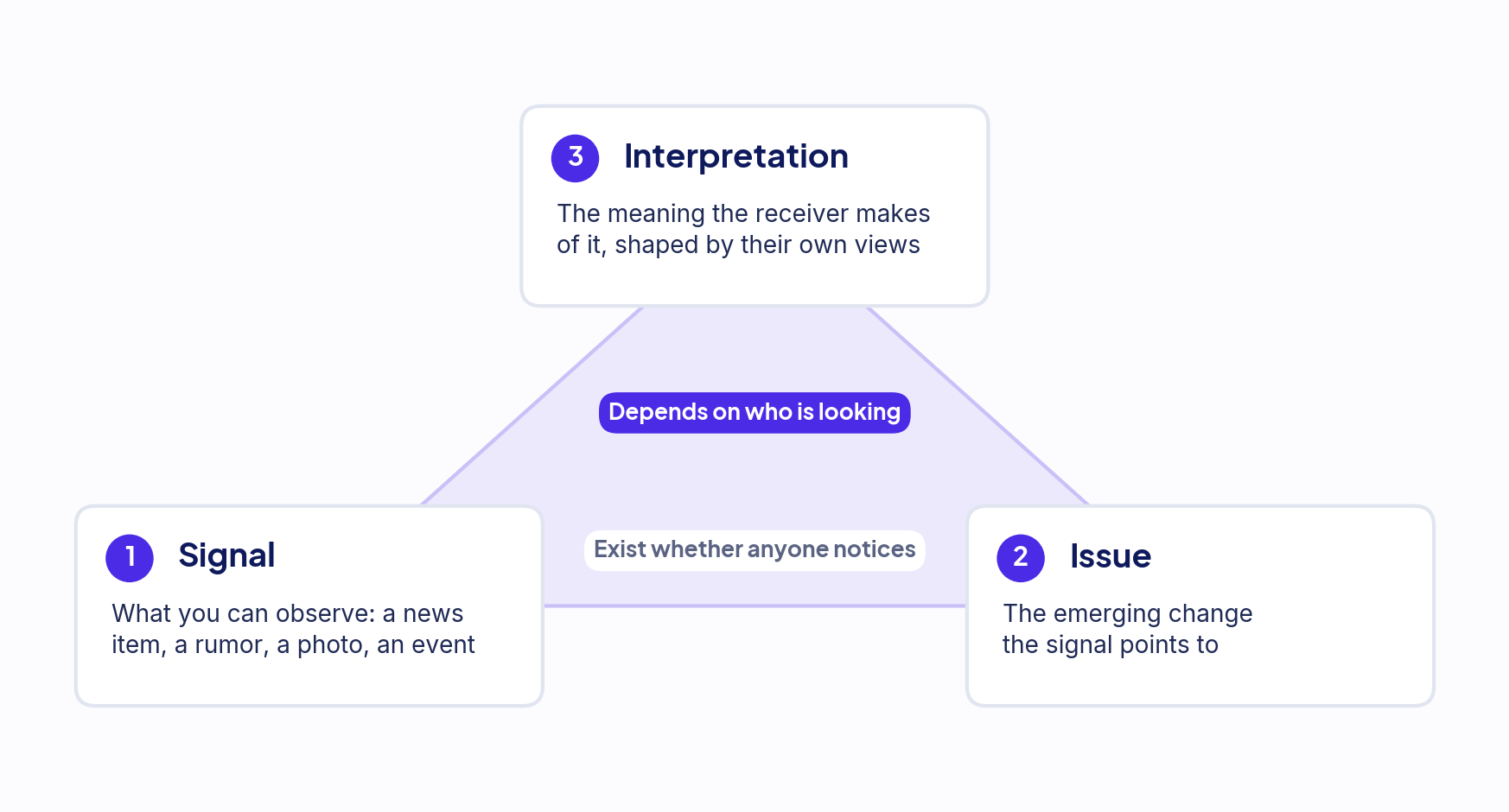
Why do some people notice a signal while others walk straight past it? One helpful model splits every signal into three parts: what you can observe (a news item, a rumor, a photo), the emerging issue behind it, and the meaning the observer gives it (3). The first two are there whether anyone notices or not. The third depends on who’s looking, which is why detection is as much about people and process as it is about data.
Why do enterprise teams need weak signal detection?
Most planning still works by projecting well-known trends forward, and recent crises have shown how much that approach can miss (4). A 2026 global foresight study drawing on 790 respondents in 132 countries found that a few weak signals act as hubs. When they strengthen, they push many other developments along with them (4). Those are the signals most worth catching early.
Catching them is hard. Relevant signals tend to arrive incomplete and mixed in with a lot of irrelevant information, and organizations usually register change only once it’s well under way (2).
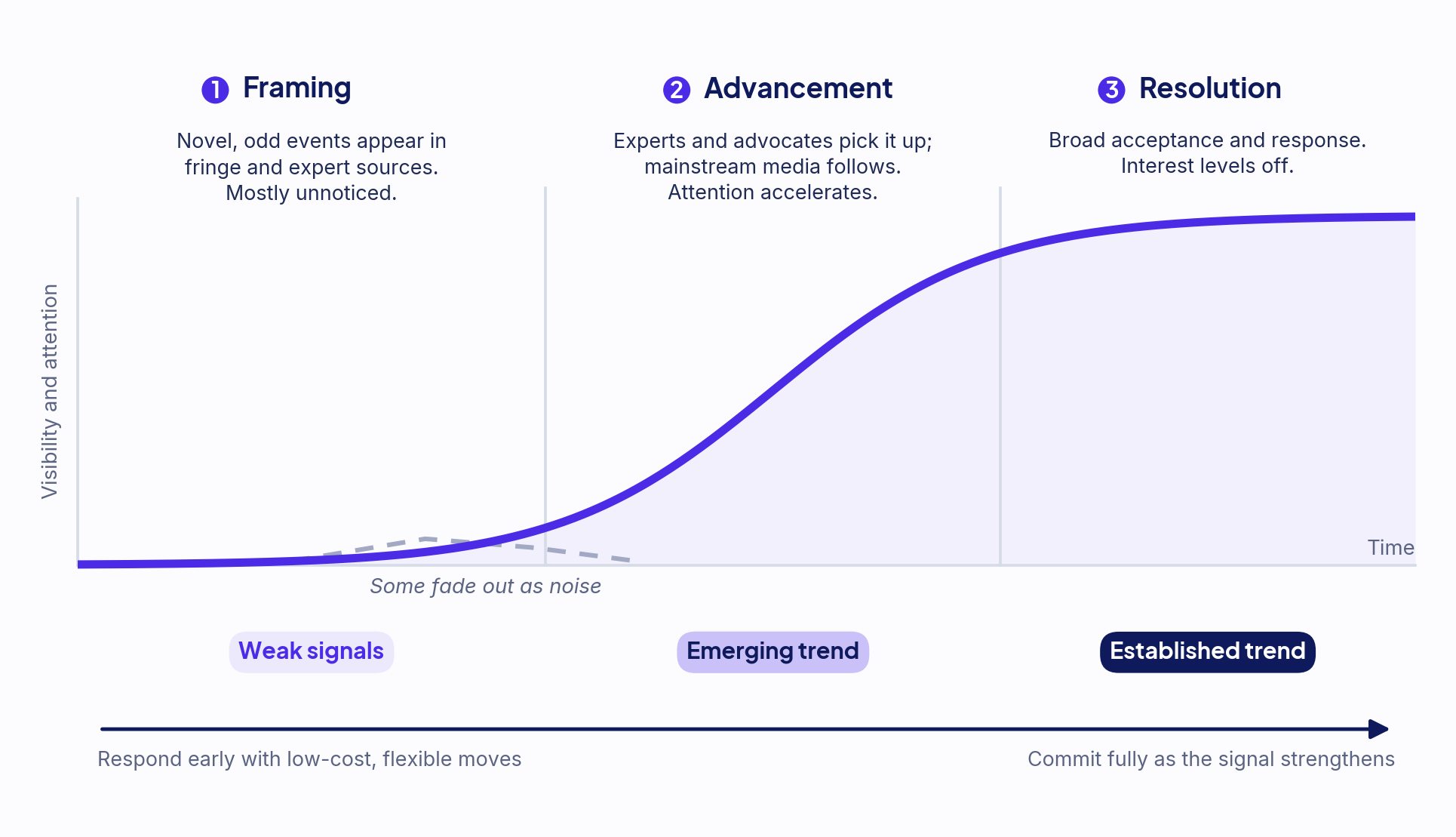
Futurist Graham Molitor described the typical path of an emerging issue as an S-curve (3). It starts with odd, isolated events that show up in fringe or specialist sources and mostly go unnoticed. Experts and advocates then start talking about it, the mainstream media picks it up, and attention climbs quickly. Eventually the issue is broadly accepted and interest flattens out. Plenty of early signals never make that climb and simply fade (3).
On timing, Ansoff’s advice still holds. Respond to weak signals early, but with small, low-cost moves, and commit more only as the signal gets stronger (3).
Tata Consultancy Services shows what acting on weak signals early looks like. In the early 2000s, with the offshore call-center business booming, TCS chose to sell its call-center operations (5). Its leaders had noticed several weak signals. Technology was moving to the cloud. Global clients would eventually want more strategic outsourced services. And TCS would need more sophisticated talent to provide them. Call centers, with their very high staff turnover, would only get in the way (5). Because the company read those signals early, it could exit while the business was still growing.
How does weak signal detection work in practice?
Weak signal detection works best as a continuous cycle, and the six steps below apply whether the aim is strategy, innovation, foresight or risk. After each step, a short note explains where Trendtracker helps.
Step 1: Scan widely, beyond your usual categories. Most scanning starts from a brief, such as tracking competitor pricing or a set of technologies. That brief decides in advance what counts as relevant, and weak signals usually sit just outside it. Asking open questions instead of filling fixed categories reduces that anchoring bias (4).
Trendtracker widens the pool of sources, monitoring 500 million documents from 20,000 curated sources, from academic papers and patents to startup databases, regulation and news. Evidence from places the team doesn’t normally read still comes through.
Step 2: Profile each candidate signal to separate signal from noise. Not every oddity is a weak signal. A real one is new, surprising, challenges existing assumptions, could matter in the future, and still needs time to mature (1). Surprise and challenge are exactly the qualities that make a signal easy to wave away in a meeting. That’s why they’re on the list.
Trendtracker’s metrics cover the measurable part of this test. Low Strength with rising mentions marks a topic that is still barely visible but gaining attention, and Horizon estimates when it may reach its forecasted strength. Fringe sources such as new patents, startups and investments help surface candidates, and the chat on each trend page helps teams work out what a signal could mean.
Step 3: Look for patterns across signals. One signal on its own rarely justifies action. What counts is whether observations from different domains point in the same direction. Think of it as a jigsaw puzzle: pieces that don’t fit the current picture are kept, because they may belong to a different one (3). Let groupings emerge from the signals rather than forcing them into familiar categories (4), and look across political, economic, social, technological, environmental and cultural domains so nothing falls through the gaps (1).
Every trend in Trendtracker has a detail page with a Weak Signals section. It lists early indicators linked to that trend, each with a short note on why it’s worth watching and a link to the original source.
EXAMPLE: WEAK SIGNALS ON A TREND PAGE
Natural GLP-1 sits at the intersection of appetite management, microbiome health and food reformulation. Its Current Trend Strength is 1.9/10 and mentions are up 53% a year, which points to emerging attention, not established adoption. Three developments merit monitoring as weak signals rather than evidence that foods can replicate medication.
1. Invisible Fiber
Pendulum’s March 2026 Gut Fuel launch combines resistant potato starch, baobab, acacia, oat beta-glucan and grape seed extract in a flavorless powder positioned around microbiome and natural GLP-1 pathways. The signal is the format: metabolic ingredients designed to disappear into existing consumption routines. For the food and beverage industry, this raises a formulation question around familiar formats, not proof of efficacy in finished products.
2. Botanical Precision
Gateway Health Alliances reported updated, peer-reviewed clinical results for Dyglomera® and CQR-300®, including DPP-4 inhibition and increased endogenous GLP-1. The weak signal is a shift from generic “eat more fiber” advice toward proprietary ingredients targeting specific biological mechanisms. Whether these findings translate into practical, safe and permissible food and beverage applications remains unresolved.
3. Metabolic Collagen
An April 2026 ingredient report describes newly developed collagen peptide compositions targeting glucose control and GLP-1 support for supplement manufacturers. The signal is protein ingredients acquiring metabolic positioning beyond muscle and recovery. This could eventually influence beverage innovation, but supplement-market development does not establish equivalent benefits, suitable doses or commercial viability in beverages.
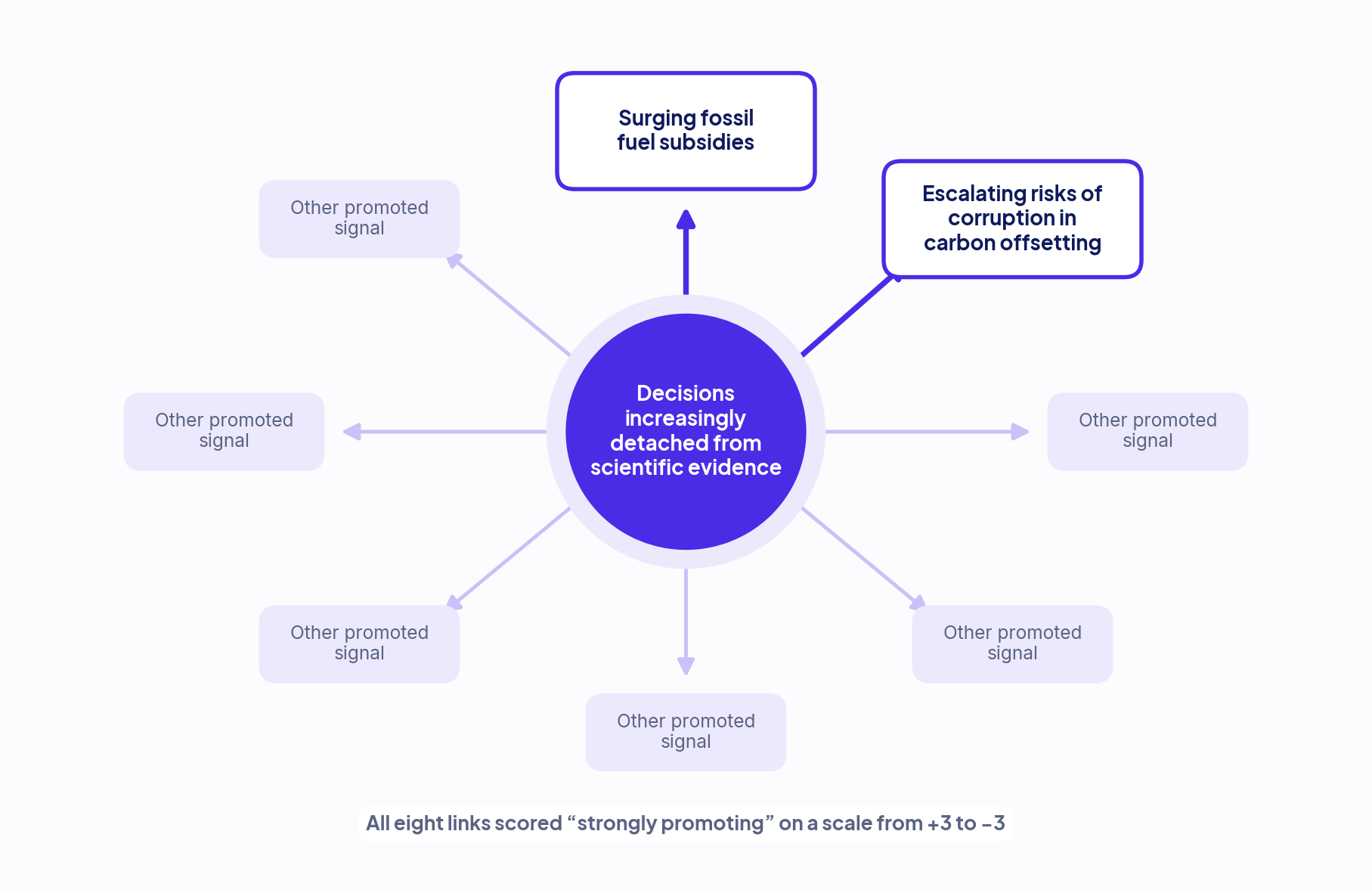
Step 4: Map how signals influence each other. Some signals matter mainly because of what they set off. Scoring how each signal strengthens or weakens the others shows which ones act as hubs (4). In the 2026 global foresight study, the most influential signal was “decisions increasingly detached from scientific evidence.” It strongly promoted eight other signals, including surging fossil fuel subsidies and corruption risks in carbon offsetting (4). On paper it’s a governance issue, yet in the network it pushes change in energy policy, climate and carbon markets. A team watching each signal separately would have missed that (4).
This step is mostly expert work. Trendtracker factors interactions between trends into its forecasts, but it doesn’t draw an influence map of this kind. What it can do is give the workshop a shared evidence base for each signal, so the discussion is about how signals interact rather than whether they’re real.
Step 5: Test before committing. A promising pattern is still only a hypothesis. Weak signals can point to opportunity, risk or both, and some turn out to be noise, so turn them into assumptions you can test cheaply (5). In the late 1990s, Mahindra & Mahindra saw weak signals that India’s growing middle class would buy capable, locally designed vehicles at local prices. Before betting $120 million on developing its Scorpio SUV, it spent about $5 million on a smaller vehicle, the Bolero, to test its assumptions (5).
How hard to commit depends on the kind of change. A good rule of thumb is to bet on demographics and hedge on systems (6). Population change is predictable enough to plan for. Changes that need regulation and social norms to shift, robotaxis for example, are slower and much harder to call (6).
Each trend in Trendtracker carries a suggested action based on the ROESI model (Recognise, Observe, Explore, Strategise, Incorporate). That graded scale fits Ansoff’s advice to commit to weak signals step by step. Forecasted Strength and Horizon add an estimate of how strong a trend may become and when. For very new topics there may not be enough data for a forecast yet.
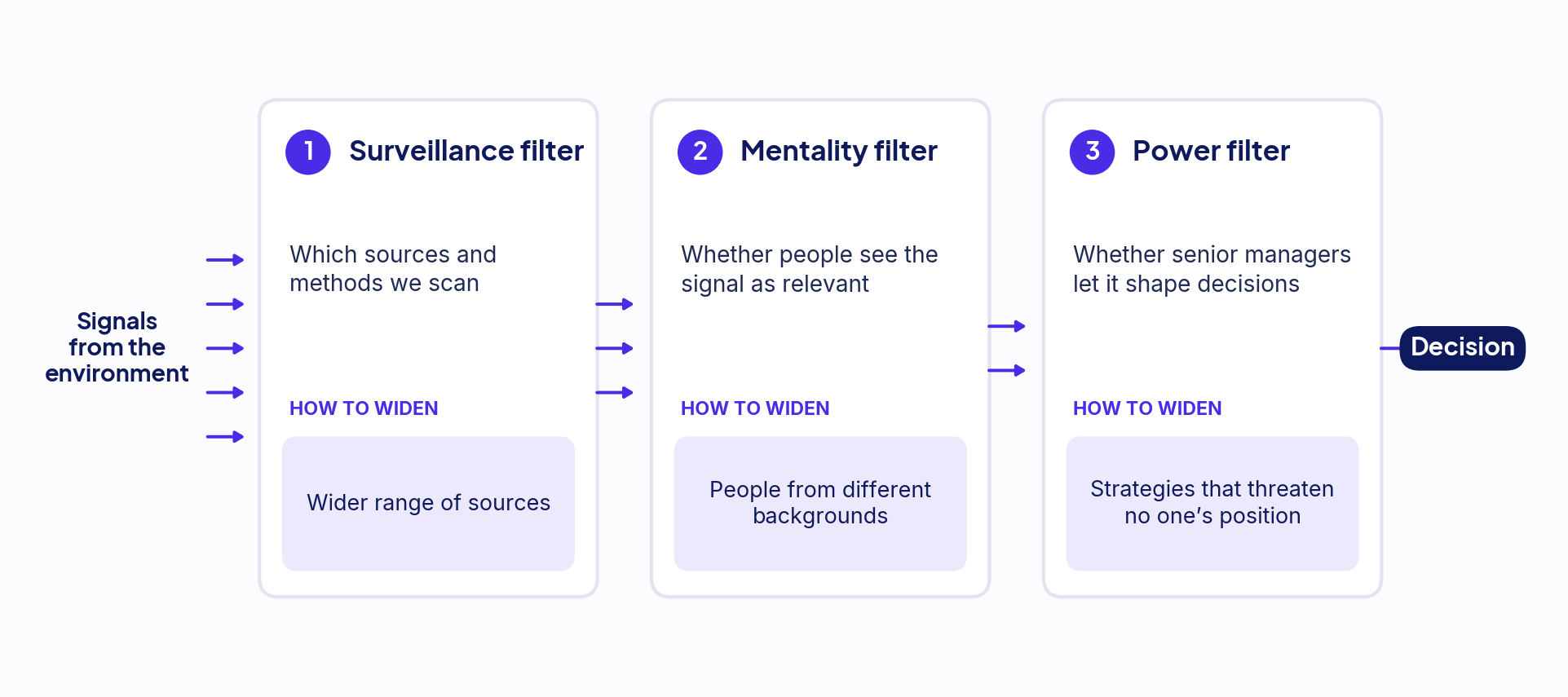
Step 6: Make sure signals reach decisions. A signal can be spotted and tested and still go nowhere. Ansoff described three filters a signal has to pass before it influences a decision (3). The first is which sources and methods the organization uses to scan. The second is the mindset of the people who receive the signal. The third is whether senior managers are willing to let new information change their decisions. Each filter can be widened by using more varied sources, involving people with different backgrounds, and designing strategies flexible enough that new signals don’t threaten anyone’s position (3). Visibility helps too. One tested approach shows images of new signals on screens in shared spaces to get people thinking about the future (3).
Trendtracker shared trend boards and radars put the same signals in front of people across departments, who can rate each one, and the AI Analyst and Trend Insights explain what a signal could mean for the organization.
Conclusion
Most organizations aren’t short of data. The harder part is collecting early evidence from beyond the usual sources, connecting it across domains, and getting it in front of the people who decide. None of the six steps is complicated, but they work best when they run all year, not only when the next plan is due.
AI-powered monitoring takes care of the part that scales: reading far more sources than any team could and keeping signals visible between planning cycles. Deciding what a signal means for the business, and what to do about it, stays with people.
References
1. Dufva, M. (2019, January 9). What is a weak signal? Sitra. https://www.sitra.fi/en/articles/what-is-a-weak-signal/
2. Mendonça, S., Cardoso, G., & Caraça, J. (2012). The strategic strength of weak signal analysis. Futures, 44(3), 218–228. https://doi.org/10.1016/j.futures.2011.10.004
3. Hiltunen, E. (2010). Weak Signals in Organizational Futures Learning (Doctoral dissertation, Acta Universitatis Oeconomicae Helsingiensis A-365). Aalto University School of Economics, Helsinki. ISBN 978-952-60-1022-9.
4. Jabbour, J., Davidson, D. J., Carlsen, H., et al. (2026). Navigating the winds of change: strategic foresight and the power of weak signals. Sustainability Science, 21, 1545–1560. https://doi.org/10.1007/s11625-025-01786-5
5. Govindarajan, V. (2016, May). Planned Opportunism: Using weak signals to spur innovation. Harvard Business Review.
6. Anthony, S. D. (2025, March 6). Four keys to effective horizon scanning. MIT Sloan Management Review. https://sloanreview.mit.edu/article/four-keys-to-effective-horizon-scanning/